
How to Sell Glass Coating Without Sounding Like a Salesperson
TL;DR: Glass coating sells itself through demonstration, not explanation. Show water beading on treated glass versus untreated glass. Position it as a safety upgrade for rain visibility, not a luxury feature. Build a system where every customer sees the demo at every consultation.
Core benefits of glass coating:
Water beads roll off windshield at speeds above 50 mph without wipers
Drivers react 25% faster to hazards through treated glass versus untreated
Reduces wiper wear and extends blade life
Lasts 2-5 years from single application
30-second demonstration closes the sale
I've watched detailers fumble this upsell for years.
They skip it entirely or turn it into a technical monologue about nanotechnology. Customers' eyes glaze over. The service sits on your menu, but it never moves because you haven't built the infrastructure to make it automatic.
Glass coating is the easiest upsell in detailing. Not because it's cheap. Not because everyone wants it. The demonstration does the selling for you.
Here's how to install this into your process so it becomes predictable revenue.
What Should You Tell Customers About Glass Coating Technology?
Stop talking about hydrophobic properties and contact angles. Customers don't care about science until they see results.
Here's my script:
"This coating changes how water behaves on your windshield. Instead of spreading out and sticking, it beads up into tight balls that roll off on their own."
Simple. Direct.
If they want more, I add: "Think about how water acts on a freshly waxed car versus dirty paint. Same principle, but engineered specifically for glass."
The coating alters the surface tension. Water droplets become rounder because they have less glass contact. Wipers remove them easier. Wind pushes them off faster. At highway speeds above 50 mph, water slides straight off without touching the wiper control.
But I don't lead with technical details. I lead with the demonstration.
What you need to know: The coating alters surface tension. Water droplets become rounder because they have less glass contact. This means easier wiper removal, faster wind clearing, and at highway speeds above 50 mph, water slides off without touching the wiper control.
How Do You Demonstrate Glass Coating Effectiveness?
You need a spray bottle filled with water and 30 seconds.
Here's the sequence:
Step 1: Spray water on an untreated section of glass. Point out how it clings, spreads, and creates a film that distorts vision.
Step 2: Spray water on a treated section. Watch it bead up instantly and roll off in tight spheres.
Step 3: Say nothing. Let them watch the difference.
The visual gap between treated and untreated glass does more than any explanation. Research on water-repellent glass shows coatings achieve contact angles with water drops over 100 degrees. That's why water beads instead of spreads.
Your customer doesn't need to know the number. They need to see the water behavior change right in front of them.
When they see it, the sale is half closed. You're confirming they want what they decided they need.
Bottom line: The visual gap between treated and untreated glass sells better than words. The demo takes 30 seconds and closes half the sale before you say another word.
Why Is Glass Coating a Safety Feature, Not a Luxury?
This is where most detailers miss the sale.
They position glass coating as a convenience feature. Nice to have. A premium add-on for people who want the best.
Wrong approach.
Glass coating is a safety upgrade.
Rain causes approximately 573,000 car accidents annually in the United States. That's nearly 50% of all weather-related crashes. Most weather-related accidents happen on wet roads during rainfall.
Your customers have driven in heavy rain at night. They know the fear of watching headlights turn into blurred halos. They've felt the anxiety of not being able to see lane markers. They've experienced panic when a car appears suddenly through the water film on their windshield.
Here's my pitch:
"You know that feeling when you're driving at night in heavy rain and you can barely see? This eliminates most of that. The water doesn't sit on your glass long enough to distort the lights or blur your vision."
Then I add data:
"Studies show drivers react to hazards 25% faster when looking through treated glass versus standard windshields. That's the difference between stopping in time and not."
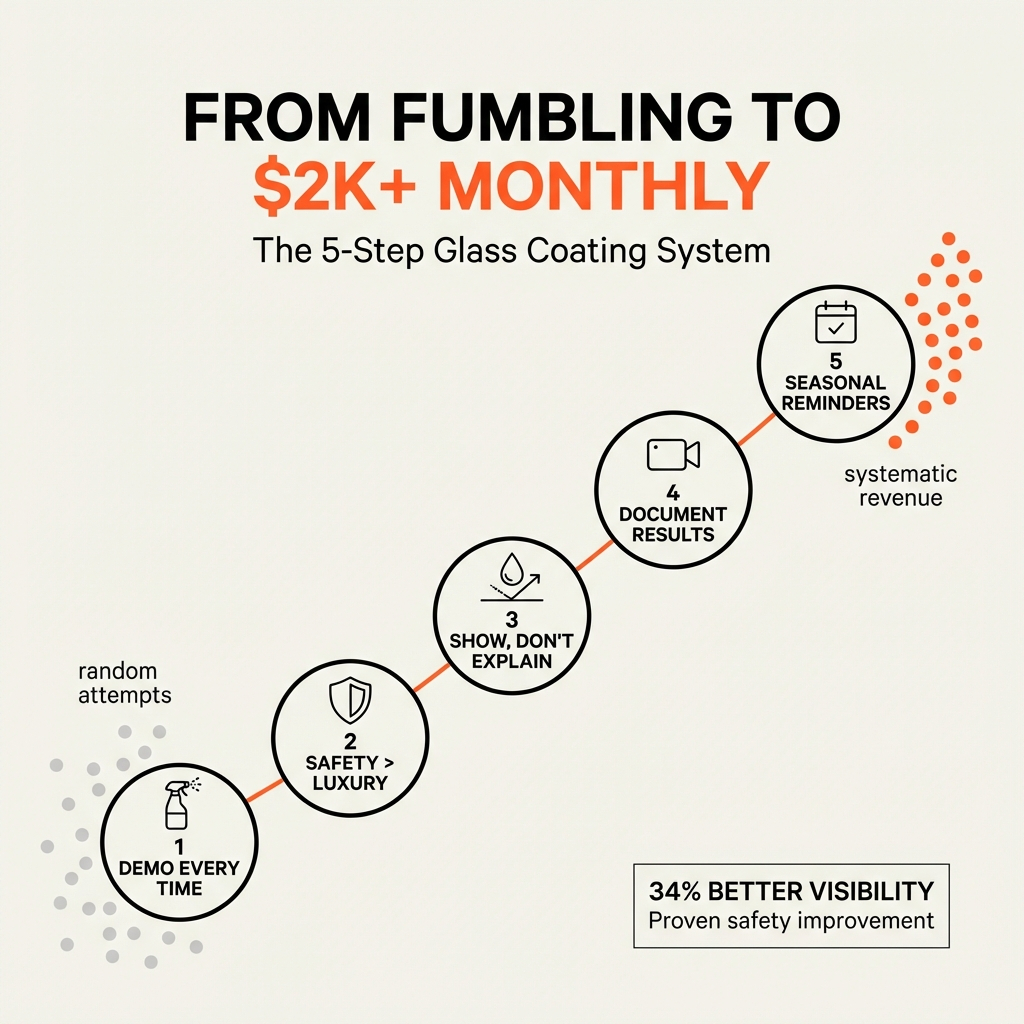
An independent study by the University of Michigan's Transportation Research Institute found hydrophobic windshield treatment improves visual awareness nearly 34% over untreated glass. Those aren't marketing numbers. Those are measurable safety improvements.
When you frame it as safety, the conversation changes. Parents with kids in the car don't hesitate. Commuters who drive in bad weather regularly see the value right away.
You're not selling coating. You're selling reaction time.
The reality: When you frame glass coating as safety infrastructure instead of luxury, parents with kids and commuters in bad weather see immediate value. You're selling reaction time, not coating.
How Does Glass Coating Reduce Wiper Wear?
Glass coating reduces how often your customer uses their wipers. Less friction means less wear. Blades last longer.
Windshield wiper replacement costs between $15 and $230 depending on the vehicle. Replace them every six to twelve months under normal conditions.
With coating applied, drivers use wipers less frequently. At higher speeds, water rolls off before the wipers need to activate. This extends blade life and reduces replacement frequency.
Here's how I position it:
"This won't eliminate wiper replacement, but most customers tell me their blades last noticeably longer. You're not dragging rubber across stuck water anymore. The coating does half the work."
This works well in harsh climates. Florida heat destroys wiper blades faster than moderate climates. Arizona sun does the same. Any region with extreme weather accelerates wear.
The coating doesn't reduce wiper usage alone. It makes cleaning easier. The same properties that repel water also prevent bugs, dirt, and road grime from bonding to the glass. A quick wipe removes what would normally require scrubbing.
People consider hydrophobic glass to be self-cleaning because the coating uses the water it repels to remove debris. That's not marketing language. That's how the surface mechanics function.
Key insight: Glass coating reduces wiper usage because water rolls off at speed. Less friction means longer blade life. The coating also prevents bugs, dirt, and road grime from bonding to glass, making cleaning easier.
What Makes Glass Coating the Easiest Upsell?
Most upsells require you to convince customers they need something they didn't know existed. Glass coating is different.
Every driver experiences poor visibility in rain. Every driver struggles with wipers that smear water around. Every driver feels the stress of night driving in bad weather.
You're not creating demand. You're offering a solution to a problem they already know they have.
The demonstration proves it works. The safety angle justifies the cost. The longevity makes the value obvious.
A single application lasts two to five years depending on climate and conditions. Years of improved visibility, reduced wiper wear, and easier cleaning from one service.
Here's the positioning:
"This is a one-time application that lasts multiple years. Most customers tell me they notice the difference every time it rains. It's not something you'll think about until you need it, and then you'll be glad it's there."
The truth: You're not creating demand. You're solving a problem every driver already knows they have. The demonstration proves it works. The safety angle justifies the cost. The longevity delivers obvious value.
What System Do You Need to Sell Glass Coating Consistently?
Glass coating doesn't sell itself. The system you build around it does the selling.
Here's what needs to be in place:
1. Demonstration capability at every consultation
Keep a spray bottle and a sample piece of treated glass in your vehicle or shop. Show the difference every time. No exceptions.
2. Safety-first positioning in all customer communication
Stop listing glass coating as a premium add-on buried in your service menu. Feature it as a safety upgrade with visibility benefits. Change how you talk about it and watch how customers respond.
3. Before-and-after documentation process
Film a quick video showing water behavior on untreated glass versus treated glass. Send it to customers after service. Let them see what they paid for.
4. Seasonal reminder system
Reach out before rainy season starts in your region. Remind previous customers when their coating is due for reapplication. Offer the service to new customers when weather makes the value clear.
5. Referral trigger at first rain event
Ask customers to text you after their first rain drive with the coating applied. Capture their reaction. Use feedback as social proof for future sales.
The goal is to remove decision friction. When the demonstration is automatic, the positioning is clear, and the value is obvious, customers stop debating.
System goal: Remove decision friction. When demonstration is automatic, positioning is clear, and value is obvious, customers stop debating. They say yes.
They just say yes.
What Does a Glass Coating Sales Process Look Like?
Customer arrives for a detail. You complete the consultation. Before pricing, you pull out your spray bottle.
"Let me show you something real quick."
You spray their windshield. Water clings and spreads. You spray your sample piece. Water beads and rolls off.
"That's what we can do to all your glass. Lasts two to five years. Makes rain driving significantly safer, especially at night. Reduces wiper wear. Makes cleaning easier."
Pause.
"Most customers add it to their detail. Makes sense to do it while we're already working on the vehicle."
That's the pitch. Thirty seconds. No pressure. Demonstration plus clear value statement.
Customers who need it take it. The ones who don't will pass. You're not convincing anyone. You're offering infrastructure to people who know they have the problem.
The process: Thirty seconds. No pressure. Demonstration plus clear value statement. Customers who need it take it. You're not convincing anyone. You're offering infrastructure to people who already know they have the problem.
What Positioning Mistake Kills Glass Coating Sales?
Detailers treat glass coating like a luxury service reserved for premium packages. They position it as something only car enthusiasts want.
That's backwards.
Glass coating serves practical drivers more than enthusiasts. The person commuting in bad weather gets more value than the person who garages their weekend car. The parent driving kids to school in the rain needs it more than the collector who avoids wet roads.
When you position it as premium luxury, you eliminate your largest market.
When you position it as practical safety infrastructure, you tap into universal demand.
Every driver experiences rain. Every driver wants better visibility. Every driver values safety.
You're not selling to a niche. You're selling to everyone who drives in weather.
Positioning shift: Glass coating serves practical drivers more than enthusiasts. Commuters in bad weather get more value than collectors who garage their cars. Position it as practical safety infrastructure, not premium luxury.
How Do You Make Glass Coating Sales Systematic?
The difference between occasional glass coating sales and consistent revenue is system presence.
Most detailers mention it sometimes. When they remember. When the customer seems interested. When the conversation goes that direction.
That's hope-dependent randomness.
Systematic infrastructure means glass coating demonstration happens at every consultation. Safety positioning appears in every service description. Visual proof gets sent after every application.
You remove the variability. You install the process. You let the system do the work.
I'm not suggesting aggressive selling. I'm suggesting consistent demonstration of value to every customer who walks through your process.
Some take it. Some won't. But everyone sees it, understands it, and knows it exists.
That's how occasional luck becomes predictable revenue.
The coating works. The demonstration proves it. The safety angle justifies it. The longevity makes the value clear.
Build the infrastructure that puts it in front of every customer, every time.
That's the system. Install it and watch what happens.
Frequently Asked Questions About Selling Glass Coating
How long does glass coating last?
A single application lasts 2-5 years depending on climate and driving conditions. Florida heat and Arizona sun reduce longevity. Moderate climates extend it.
Do you need special equipment to demonstrate glass coating?
No. You need a spray bottle filled with water and a sample piece of treated glass. The demonstration takes 30 seconds and shows the difference between treated and untreated surfaces.
What should you say when customers ask about the science?
Keep it simple: The coating changes how water behaves on glass. Instead of spreading and sticking, water beads into tight balls that roll off. If they want more detail, compare it to how water acts on waxed car paint versus dirty paint.
How do you price glass coating services?
Position it as a safety upgrade, not a premium luxury feature. Frame the cost against 2-5 years of improved visibility, reduced wiper replacement, and easier cleaning. Most customers see value when you explain longevity.
When is the best time to offer glass coating?
At every consultation without exception. Reach out before rainy season starts in your region. Remind previous customers when reapplication is due. Offer to new customers when weather makes value clear.
Does glass coating eliminate the need for windshield wipers?
No. At speeds above 50 mph, water rolls off without wipers. Below that speed or in heavy rain, you still need wipers. The coating reduces wiper usage and extends blade life because there's less friction.
What results can customers expect in different weather conditions?
Night rain driving improves dramatically. Water doesn't sit long enough to distort lights or blur vision. Studies show drivers react 25% faster to hazards through treated glass. Visual awareness improves nearly 34% over untreated windshields.
How do you follow up after applying glass coating?
Film a quick video showing water behavior on treated glass. Send it after service. Ask customers to text you after their first rain drive with the coating. Capture reactions and use feedback as social proof.
Key Takeaways
Glass coating sells through demonstration, not explanation. Show water beading on treated glass versus untreated glass in 30 seconds.
Position glass coating as safety infrastructure, not luxury. Drivers react 25% faster to hazards through treated glass. Rain causes 573,000 accidents annually in the US.
Build a system where every customer sees the demo at every consultation. Remove decision friction by making demonstration automatic.
Glass coating reduces wiper wear because water rolls off at highway speeds. Blades last longer with less friction.
A single application lasts 2-5 years. That's years of improved visibility, reduced maintenance, and easier cleaning from one service.
The biggest mistake is positioning glass coating as premium luxury instead of practical safety. Commuters and parents get more value than car enthusiasts.
Make glass coating systematic, not occasional. Install the process so demonstration happens every time, not just when you remember.