
The Convenience Premium Nobody's Charging: Why Your Mobile Service Costs More to Deliver Than Shop Work
TL;DR: Mobile locksmith service costs more to deliver than shop work because of fuel, vehicle wear, travel time, and unpredictable delays. Consumers pay an 11% premium for each convenience layer, yet most locksmiths undercharge for mobile service while underselling shop advantages. The solution is treating service location as a feature, not a limitation, and pricing each format based on the value delivered.
Mobile service eliminates customer travel time and solves problems at the exact location where they occur. Shop service provides product comparison, expert consultation, and 70% customer retention compared to 30% for mobile-only operations. Neither format competes with the other. They serve different customer needs and deserve different pricing structures.
What You Need to Know
Mobile service has higher variable costs (fuel, vehicle maintenance, travel time) that shops don't face
Consumers pay an 11% premium for each convenience layer, making mobile service worth more than a $5 or $10 upcharge
Shop locations generate 70% customer retention versus 30% for mobile-only operations
Hybrid models work when you match service format to customer need rather than treating them as competing alternatives
Premium pricing requires operational infrastructure that supports consistent delivery for both formats
Why Most Locksmiths Undercharge for Mobile Service
Locksmiths price mobile service like a slight upcharge on shop work.
Five dollars more. Ten dollars more. Sometimes nothing at all.
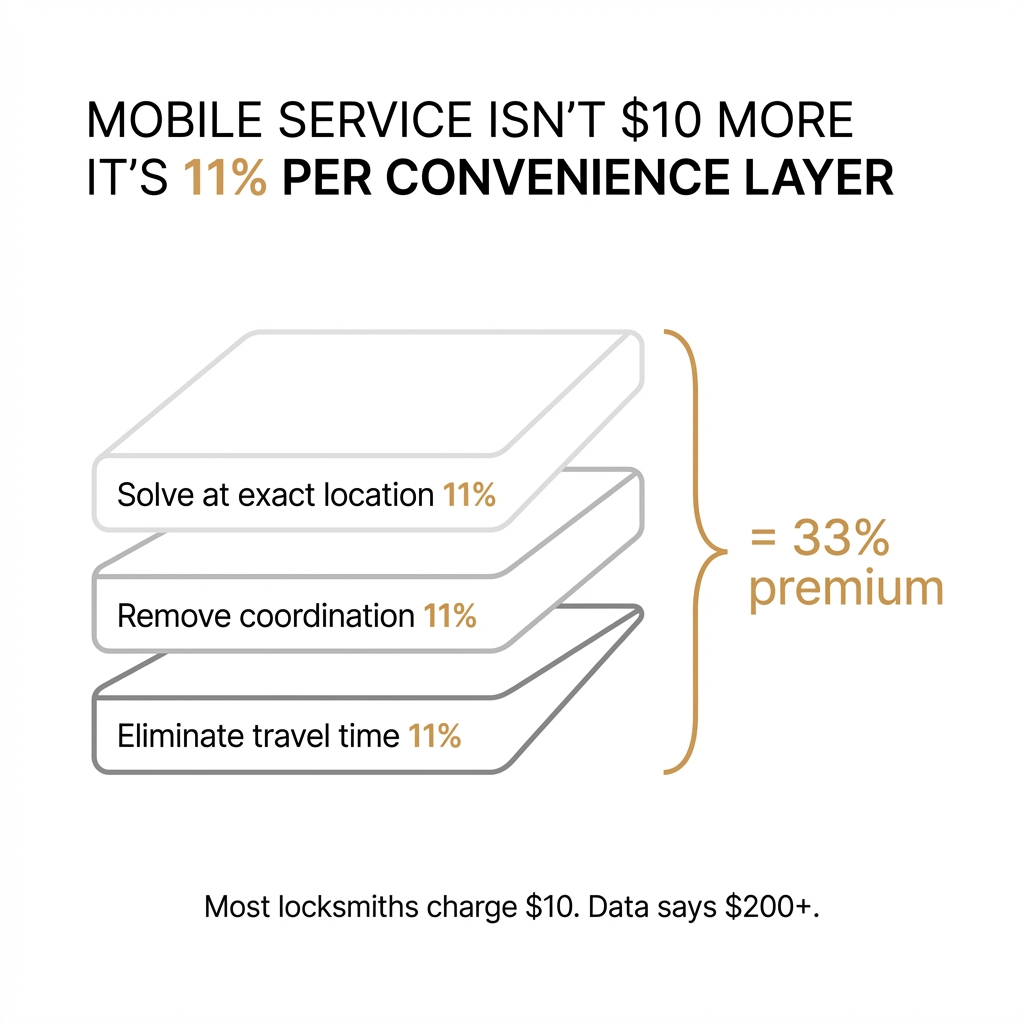
The data shows consumers pay an 11% premium for each layer of convenience added to a service. Not 5%. Not 10%. Eleven percent per convenience layer.
Mobile locksmith work has multiple convenience layers built in.
You eliminate the customer's travel time. You remove the coordination hassle of getting a key or lock to your shop. You solve the problem at the exact moment and location where it exists.
This structural value delivery gets undersold by hundreds of dollars per year.
Bottom line: Mobile service delivers multiple convenience layers worth 11% premiums each, not flat $10 fees.
Five dollars more. Ten dollars more. Sometimes nothing at all.
Meanwhile, the data shows consumers pay an 11% premium for each layer of convenience added to a service. Not 5%. Not 10%. Eleven percent per convenience layer.
And mobile locksmith work has multiple convenience layers built in.
You eliminate the customer's travel time. You remove the coordination hassle of getting a key or lock to your shop. You solve the problem at the exact moment and location where it exists.
That's not a $10 convenience fee. That's structural value delivery most locksmiths undersell by hundreds of dollars per year.
What Mobile Service Actually Costs to Deliver
Mobile work costs more to deliver than shop work, even though everyone assumes the opposite.
The startup cost difference looks appealing at first glance. Mobile locksmith operations require $10,000 to $50,000 in initial investment. Brick-and-mortar setups start around $18,700 plus monthly rent and utilities.
The cost advantage ends there.
Variable Costs That Shops Don't Deal With
Mobile operations face expenses that shops avoid:
The startup cost difference looks appealing at first glance. Mobile locksmith operations require $10,000 to $50,000 in initial investment compared to brick-and-mortar setups starting around $18,700 plus monthly rent and utilities.
But that's where the cost advantage ends.
Mobile operations face variable costs that shops don't deal with:
Fuel expenses fluctuate with gas prices and service radius
Vehicle maintenance and depreciation accelerate with commercial use
Traffic delays make job duration unpredictable
Weather conditions slow service delivery
Geographic spread creates dead time between jobs
How Shop Economics Work Differently
Shop-based work has the opposite cost profile. Fixed costs stay constant regardless of volume. Once overhead is covered, additional jobs become increasingly profitable because per-unit costs drop.
A mobile locksmith doing 20 jobs in a week has roughly the same fuel and vehicle costs as one doing 25 jobs. A shop doing 25 jobs uses the same rent and utilities as one doing 20 jobs.
The shop model rewards volume. The mobile model punishes inefficiency.
Key insight: Mobile service carries higher variable costs per job while shops benefit from fixed cost leverage at higher volumes.
A mobile locksmith doing 20 jobs in a week has roughly the same fuel and vehicle costs as one doing 25 jobs. A shop doing 25 jobs uses the same rent and utilities as one doing 20 jobs.
The shop model rewards volume. The mobile model punishes inefficiency.
Shop Advantages You're Probably Underselling
Physical locations have advantages mobile operators spend too much energy trying to overcome instead of leveraging.
Customer Retention Rates
Customer retention runs 70% for brick-and-mortar businesses compared to 30% for purely mobile or online operations. This structural advantage compounds over time.
Product Interaction Drives Higher Sales
Shops provide something mobile service doesn't replicate: the ability to browse, compare, and touch products before purchase. You display security hardware, demonstrate lock mechanisms, and let customers feel the quality difference between a $30 deadbolt and a $200 one.
That sensory experience drives higher-ticket sales.
Mobile locksmiths carry limited inventory by necessity. You show pictures or describe products verbally. The customer makes decisions based on trust and description rather than direct comparison.
Incidental Revenue Opportunities
Shops create what I call incidental revenue opportunities. A customer comes in for a key copy and sees your display of smart locks. They ask questions. Three weeks later they call you for an installation.
This doesn't happen when you're kneeling in someone's driveway rekeying a lock.
Post-pandemic data shows 94% of customers are returning to physical stores because they value interacting with products and receiving immediate staff assistance.
You're not fighting an uphill battle. You're operating in a format customers prefer for certain transaction types.
Core principle: Shops excel at product comparison, expert consultation, and generating repeat business through direct customer relationships.
Customer retention runs 70% for brick-and-mortar businesses compared to 30% for purely mobile or online operations. That's not a small difference. That's a structural advantage that compounds over time.
Shops provide something mobile service can't replicate: the ability to browse, compare, and touch products before purchase. You can display security hardware, demonstrate lock mechanisms, and let customers feel the quality difference between a $30 deadbolt and a $200 one.
That sensory experience drives higher-ticket sales.
Mobile locksmiths carry limited inventory by necessity. You show pictures or describe products verbally. The customer makes decisions based on trust and your description rather than direct comparison.
Shops also create what I call "incidental revenue opportunities." A customer comes in for a key copy and sees your display of smart locks. They ask questions. Three weeks later they call you for an installation.
That doesn't happen when you're kneeling in someone's driveway rekeying a lock.
Post-pandemic data shows 94% of customers are returning to physical stores specifically because they value interacting with products and receiving immediate staff assistance.
You're not fighting an uphill battle. You're operating in a format customers actively prefer for certain transaction types.
Why Treating Mobile and Shop as Competitors Costs You Money
Most locksmiths position mobile and shop service as competing alternatives instead of complementary offerings serving different customer needs.
This creates internal conflict.
You undercharge for mobile service because you don't want customers to feel penalized for needing you to come to them. You undervalue shop service because you assume customers choose it only when mobile isn't available.
Both assumptions cost you money.
What the Research Shows About Convenience
The research shows 83% of consumers say convenience is more important to them now than five years ago. And 97% have abandoned a purchase because it was inconvenient.
Convenience is a primary purchase driver, not a nice-to-have.
But convenience means different things in different contexts.
For a lockout at 11 PM, convenience means you come to them immediately. For a business upgrading their access control system, convenience means they visit your shop, see multiple options, get expert consultation, and make an informed decision without time pressure.
Same customer. Different convenience requirements. Different value propositions.
Reality check: Convenience drives purchase decisions, but what counts as convenient changes based on the customer's specific situation and need.
That creates internal conflict.
You undercharge for mobile service because you don't want customers to feel penalized for needing you to come to them. You undervalue shop service because you assume customers only choose it when mobile isn't available.
Both assumptions cost you money.
The research shows 83% of consumers say convenience is more important to them now than five years ago. And 97% have abandoned a purchase specifically because it was inconvenient.
Convenience isn't a nice-to-have. It's a primary purchase driver.
But convenience means different things in different contexts.
For a lockout at 11 PM, convenience means you come to them immediately. For a business upgrading their access control system, convenience means they can visit your shop, see multiple options, get expert consultation, and make an informed decision without time pressure.
Same customer. Different convenience requirements. Different value propositions.
How to Position Each Service Format as a Feature
Mobile Service Positioning
You're selling time recovery and problem resolution at the point of need. The customer doesn't coordinate transportation, doesn't wait for shop hours, doesn't manage the logistics of getting a lock or vehicle to you.
This is worth more than your current pricing reflects.
Research on repair service pricing shows that as products become more expensive, price sensitivity decreases while convenience attributes become more important.
Your higher-value services justify higher convenience premiums.
Shop Service Positioning
You're selling expertise, selection, and the ability to make better decisions through direct product interaction. Customers compare options, ask detailed questions, and leave with exactly what they need.
Stop positioning your shop as the place you go when mobile isn't available. Position it as the place you go when you want to make the best decision about security hardware.
Positioning shift: Treat each service format as the best solution for specific customer needs, not as interchangeable options competing on price.
That's worth more than your current pricing reflects.
Research on repair service pricing shows that as products become more expensive, price sensitivity decreases while convenience attributes become more important.
Your higher-value services justify higher convenience premiums.
Shop positioning: You're selling expertise, selection, and the ability to make better decisions through direct product interaction. Customers can compare options, ask detailed questions, and leave with exactly what they need.
Stop positioning your shop as "the place you go when mobile isn't available." Position it as "the place you go when you want to make the best decision about security hardware."
The Hybrid Model That Works in Practice
The locksmiths I work with who run both mobile and shop operations profitably do something specific: they treat service location as a product feature, not a business model choice.
They don't ask, "Should we be mobile or brick-and-mortar?"
They ask, "Which service location creates the most value for this specific customer need?"
How to Match Service Format to Customer Need
Emergency service: Always mobile. Premium pricing justified by immediate response and location convenience. The alternative is the customer breaking a window or sleeping in their car.
Security consultations and upgrades: Shop preferred. You want the customer seeing your full product range, understanding quality differences, and making decisions without time pressure. The shop environment supports higher-ticket sales.
Routine service for commercial clients: Hybrid approach. Initial consultation at their location to understand their security setup and needs. Product selection and detailed planning at your shop where you show options. Installation at their location.
Key duplication and simple hardware sales: Shop default with mobile available at premium pricing for customers who need immediate service.
This isn't complicated strategy. It's matching service delivery format to customer value perception.
Strategy summary: Choose service format based on what creates maximum value for each customer situation, then price accordingly.
They don't ask "Should we be mobile or brick-and-mortar?"
They ask "Which service location creates the most value for this specific customer need?"
Here's what that looks like in practice:
Emergency service: Always mobile. Premium pricing justified by immediate response and location convenience. No apologizing for the premium. The alternative is the customer breaking a window or sleeping in their car.
Security consultations and upgrades: Shop preferred. You want the customer seeing your full product range, understanding quality differences, and making decisions without time pressure. The shop environment supports higher-ticket sales.
Routine service for commercial clients: Hybrid approach. Initial consultation at their location to understand their security setup and needs. Product selection and detailed planning at your shop where you can show options. Installation at their location.
Key duplication and simple hardware sales: Shop default with mobile available at premium pricing for customers who need immediate service.
This isn't complicated strategy. It's matching service delivery format to customer value perception.
What Happens When You Stop Competing With Yourself
The revenue impact shows up in three places:
Higher Average Transaction Values
When customers visit your shop for security upgrades, they see premium options they wouldn't consider based on verbal description alone. Your average hardware sale increases because comparison selling works.
Better Margin on Mobile Service
When you position mobile work as premium convenience rather than standard service delivery, you charge what it costs to deliver plus appropriate profit margin. Your mobile revenue per job increases while your cost structure stays the same.
Reduced Customer Acquisition Cost
Physical locations generate 70% customer retention compared to 30% for mobile-only operations. You spend less replacing customers who don't come back.
The pattern I see repeatedly: locksmiths undercharge for mobile convenience and undersell shop advantages. They position both service formats as commodity offerings differentiated only by customer preference.
This leaves money on the table in both directions.
Consumers are willing to pay a 5% premium for convenience on average across industries, with younger demographics willing to pay even more. Over half of consumers will pay substantially more for products offering significant convenience.
You're not asking for something unreasonable when you charge appropriately for mobile service. You're capturing value you're already delivering but not getting paid for.
Financial impact: Proper positioning increases transaction values, improves margins, and reduces acquisition costs across both service formats.
Higher average transaction values: When customers visit your shop for security upgrades, they see premium options they wouldn't consider based on verbal description alone. Your average hardware sale increases because comparison selling works.
Better margin on mobile service: When you position mobile work as premium convenience rather than standard service delivery, you charge what it actually costs to deliver plus appropriate profit margin. Your mobile revenue per job increases while your cost structure stays the same.
Reduced customer acquisition cost: Physical locations generate 70% customer retention compared to 30% for mobile-only operations. You spend less replacing customers who don't come back.
The pattern I see repeatedly: locksmiths undercharge for mobile convenience and undersell shop advantages. They position both service formats as commodity offerings differentiated only by customer preference.
That leaves money on the table in both directions.
Consumers are willing to pay a 5% premium for convenience on average across industries, with younger demographics willing to pay even more. Over half of consumers will pay substantially more for products offering significant convenience.
You're not asking for something unreasonable when you charge appropriately for mobile service. You're capturing value you're already delivering but not getting paid for.
The Infrastructure Required to Support Premium Pricing
Pricing strategy only works if your operational infrastructure supports it.
You need systems in place before you change pricing.
You won't charge premium rates for mobile convenience if your response time is unpredictable. You won't position your shop as the expert consultation destination if customers struggle to schedule appointments or your product displays look disorganized.
What Working Hybrid Models Have in Common
The locksmiths who make hybrid models work have systems that support both service formats:
Scheduling infrastructure that routes mobile jobs efficiently and protects shop consultation time from constant interruption.
Inventory management that keeps mobile vehicles stocked with high-turnover items while maintaining comprehensive product selection at the shop.
Pricing architecture that communicates value differences clearly without making customers feel penalized for choosing mobile service.
Marketing systems that direct different customer types to appropriate service formats based on their needs.
Where Most Locksmiths Get Stuck
This is where most locksmiths hit a wall. They understand the pricing theory but lack the operational infrastructure to execute it consistently.
You end up with ad hoc pricing decisions, inconsistent service delivery, and customer confusion about when to call for mobile service versus visiting the shop.
The solution isn't more complex. It's more systematic.
You need conversion infrastructure that presents service options clearly, scheduling systems that optimize for both mobile efficiency and shop traffic, and pricing models that reflect value delivery rather than arbitrary upcharges.
This is the work I do with locksmiths through Wink & Win. Not teaching pricing theory. Installing the operational systems that make premium positioning sustainable.
If you're running both mobile and shop operations but feeling like you're competing with yourself on price, the problem isn't your pricing. It's the infrastructure that should be supporting your pricing but doesn't exist yet.
Implementation reality: Premium pricing requires operational systems that deliver consistent value. Theory without infrastructure fails.
You can't charge premium rates for mobile convenience if your response time is unpredictable. You can't position your shop as the expert consultation destination if customers can't easily schedule appointments or your product displays look like a hardware store clearance section.
The locksmiths who make hybrid models work have systems that support both service formats:
Scheduling infrastructure that routes mobile jobs efficiently and protects shop consultation time from constant interruption.
Inventory management that keeps mobile vehicles stocked with high-turnover items while maintaining comprehensive product selection at the shop.
Pricing architecture that communicates value differences clearly without making customers feel penalized for choosing mobile service.
Marketing systems that direct different customer types to appropriate service formats based on their needs.
This is where most locksmiths get stuck. They understand the pricing theory but lack the operational infrastructure to execute it consistently.
You end up with ad hoc pricing decisions, inconsistent service delivery, and customer confusion about when to call for mobile service versus visiting the shop.
The solution isn't more complex. It's more systematic.
You need conversion infrastructure that presents service options clearly, scheduling systems that optimize for both mobile efficiency and shop traffic, and pricing models that reflect actual value delivery rather than arbitrary upcharges.
That's the work I do with locksmiths through Wink & Win. Not teaching pricing theory. Installing the operational systems that make premium positioning sustainable.
Frequently Asked Questions
How much should I charge for mobile locksmith service?
Charge based on the convenience value delivered, not a flat upcharge. Research shows consumers pay an 11% premium for each convenience layer. Mobile service eliminates customer travel, solves problems on location, and works around customer schedules. Price this at 20% to 40% above shop rates depending on urgency and distance.
Why do customers prefer brick-and-mortar shops over mobile service?
Customers prefer shops for product comparison, expert consultation, and non-emergency purchases. 94% of customers return to physical stores to interact with products and get immediate staff assistance. Shops work better when customers want to make informed decisions without time pressure.
What's the biggest cost difference between mobile and shop operations?
Mobile operations face variable costs per job: fuel, vehicle maintenance, travel time, and weather delays. Shops have fixed costs that stay constant regardless of volume. Once a shop covers overhead, additional jobs become more profitable. Mobile costs scale with every job.
How do I stop competing with myself on price between mobile and shop service?
Treat service location as a feature that solves different customer problems. Mobile serves emergencies and time-sensitive needs. Shop serves consultation, product selection, and planned purchases. Match the service format to what the customer values most in that situation.
What infrastructure do I need before raising mobile service prices?
You need reliable response times, efficient routing systems, clear pricing communication, and consistent service delivery. Premium pricing requires premium execution. Install scheduling infrastructure, inventory management, and marketing systems that direct customers to the right service format before changing prices.
Why is customer retention higher for shops than mobile-only operations?
Shops generate 70% customer retention versus 30% for mobile-only operations because physical locations create ongoing relationships. Customers return for additional purchases, see new products, and build familiarity with your business. Mobile service is transactional. Shop relationships compound over time.
When should I recommend shop service instead of mobile?
Recommend shop service for security upgrades, commercial access control consultations, non-emergency hardware purchases, and whenever the customer benefits from seeing product options in person. Shop visits support higher-ticket sales through product comparison and expert guidance.
How do hybrid locksmith businesses handle scheduling?
Hybrid businesses use scheduling systems that route mobile jobs for efficiency while protecting shop consultation time. They set clear expectations about which services require appointments and which offer immediate mobile response. The system prevents mobile emergencies from constantly interrupting shop consultations.
Key Takeaways
Mobile service costs more to deliver than shop work because of fuel, vehicle maintenance, travel time, and unpredictable delays. Price mobile service 20% to 40% above shop rates to capture the convenience value you're delivering.
Shops generate 70% customer retention compared to 30% for mobile-only operations. Physical locations create ongoing relationships, incidental revenue opportunities, and higher-ticket sales through product comparison.
Consumers pay an 11% premium for each convenience layer. Mobile service delivers multiple convenience layers: eliminated travel time, on-location service, and problem resolution at the exact moment of need.
Treat service location as a feature, not a limitation. Mobile serves emergencies and time-sensitive needs. Shop serves consultation, product selection, and planned purchases. Neither format competes with the other.
Premium pricing requires operational infrastructure. Install scheduling systems, inventory management, pricing architecture, and marketing that matches customers to the right service format before raising prices.
Stop positioning mobile and shop as competing alternatives. They serve different customer needs and deserve different pricing structures based on the value each format delivers.
Your pricing problem is an infrastructure problem. You need conversion systems, efficient routing, clear value communication, and consistent delivery across both formats to make premium positioning sustainable.
Let's fix that. winkandwin.com