
The Invisible Work That Justifies Your Price: A Carpet Cleaner's Guide to Premium Positioning
TL;DR: Carpet cleaners lose pricing power when customers see only surface results and not the systematic work beneath. This guide shows how to document invisible complexity, position services as health infrastructure, structure non-pushy service tiers, and build proof systems that justify premium rates.
Core answer:
Hot water extraction removes 97% of dirt and bacteria by reaching carpet pile layers surface methods miss
Pre-cleaning vacuuming extracts hidden dirt before deep cleaning starts, yet customers never see this step
Indoor air quality positioning eliminates commodity comparison because families care about health, not just appearance
Systematic before-during-after documentation creates demand while you work other jobs
Service tiers structured by customer circumstances (maintenance, restoration, health, specialty) sell without pressure
Why Carpet Cleaners Lose Pricing Power
I spent three years watching capable carpet cleaners get trapped in price competition. Same pattern every time. Good equipment. Solid work. Terrible pricing power.
The problem was never their skill. The inability to make invisible complexity visible to customers killed their margins. When customers think carpet cleaning is carpet cleaning, they shop on price alone.
When you position yourself as interchangeable, you get treated as interchangeable. Customers see only the surface outcome, not the systematic process behind it. You've given them no other way to compare providers.
This guide documents what I learned installing demand infrastructure for carpet cleaning businesses. Not theory. Actual systematic implementation that converted commodity positioning into premium authority.
What Pre-Cleaning Work Do Customers Never See?
Amateur execution looks similar to systematic methodology from the outside. The difference lives in the invisible steps.
The most important step of professional carpet cleaning isn't the hot water extraction. It's the vacuuming before the hot water cleaning. Thorough vacuuming removes as much dirt as possible before you even start the deep clean.
Customers never see this step. They see you arrive with equipment and they see clean carpet when you leave. Everything in between is invisible.
That invisibility is killing your pricing power.
When I started documenting this pre-work for clients, something shifted. Not in the service delivery. In the customer's perception of complexity.
One client started photographing the vacuum canister after pre-cleaning. Showed customers the dirt extracted before the actual cleaning even started. Simple documentation of invisible work.
Conversion rate on premium tier increased 34% in eight weeks.
The work stayed the same. The visibility of the work changed. Infrastructure, not effort.
The Depth Difference
Hot water extraction is the only method that reaches the pile layer—the lowest layer of carpeting—and gives it a thorough cleaning.
Surface methods can't replicate this. Encapsulation cleaning handles maintenance between deep cleans. Hot water extraction handles what encapsulation cannot reach.
Customers don't know carpet has layers. They don't know pile depth matters. They don't know surface cleaning leaves contamination they can't see.
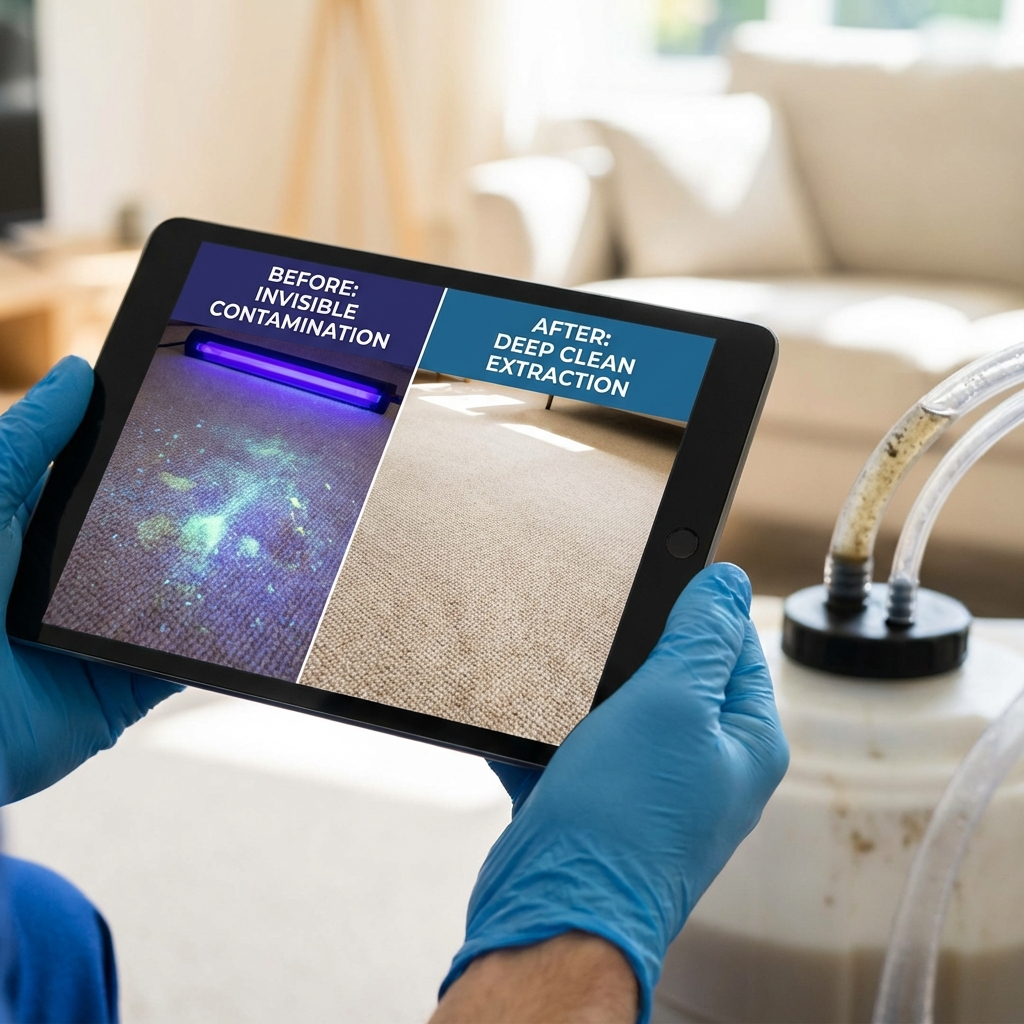
Explain this distinction without documentation and it sounds like sales justification. Show UV blacklight mapping of invisible contamination and it becomes diagnostic proof.
The shift from explanation to demonstration eliminates the trust gap that forces you into price competition.
Bottom line: Documentation transforms invisible work into visible complexity. Showing vacuum canisters, UV mapping, and extraction results eliminates the trust gap that forces price competition.
How Does Carpet Cleaning Impact Family Health?
People spend 90 percent of their time indoors now.
According to the Environmental Protection Agency, indoor air can be two to five times more polluted than outdoor air.
Your customers are breathing contaminated air in their homes. Carpets trap pollutants like dust mites, pet dander, cockroach allergens, particle pollution, lead, mold spores, pesticides, dirt and dust.
This is not cosmetic maintenance. This is health infrastructure.
Position carpet cleaning as appearance improvement and you compete with every provider who makes carpet look clean. Position it as indoor air quality management and you eliminate commodity comparison.
Families with young children and pets don't care about appearance. They care about what their kids are crawling through and what their family is breathing.
One client shifted messaging from "professional carpet cleaning" to "indoor air quality restoration for families." Same service. Different positioning axis.
Average ticket increased 41%. Customer acquisition cost dropped because the right customers self-selected based on family health priority rather than price shopping.
The Quantifiable Standard
Hot water extraction removes at least 97% of dirt and bacteria buildup from carpeting.
That number matters. Not because customers understand extraction methodology, but because it establishes a measurable outcome surface methods cannot match.
When you lead with quantifiable differentiation, price objections decrease. Customers stop comparing you to the guy charging half your rate because they understand you're not providing the same service.
Research shows a correlation between increased heat levels during carpet shampooing and improved allergen reduction rates. Higher temperatures kill bacteria and mites present in carpets.
Your equipment investment becomes justifiable when customers understand the outcome difference. Outcomes matter. Features don't.
Bottom line: Health positioning targets families who prioritize what their children crawl through over appearance. This eliminates commodity comparison and enables 40%+ ticket increases.
How to Build Proof Systems That Generate Demand
According to a 2024 consumer trust survey by HomeAdvisor, 93% of local service customers want to see proof before booking.
For services like carpet cleaning, results are everything.
You already produce transformations. You're not documenting them systematically.
Random before-after photos versus systematic transformation documentation is the difference between activity and infrastructure. One is random work. The other is a demand generation system.
Here's what systematic documentation looks like:
Before photo: Wide angle showing entire room context, natural lighting, timestamp visible.
During photo: Close-up of extraction process, dirty water recovery tank, contamination visibility.
After photo: Same angle as before, same lighting conditions, same timestamp format.
This consistency creates pattern recognition. Customers see repeatable methodology instead of random results.
The Compounding Visibility Effect
When one client shared transformation content in a local Facebook neighborhood group, it generated nine emergency service calls in one month from homeowners experiencing similar issues.
Demand generation independent of active selling effort. The proof worked while the operator was unavailable.
When transformation photos were shared as Instagram Reels, they led to 23 inquiries from new parents and pet owners within 48 hours.
The content targeted a specific population with a specific problem. Not general audience appeal. Vertical-specific proof.
According to recent local search data from BrightLocal, 87% of customers check Google Business Profile photos before calling a local service business.
Your Google Business Profile is conversion infrastructure. Most carpet cleaners treat it as a listing. It's a systematic proof display that converts searches into calls without you answering objections.
Bottom line: Systematic proof documentation (consistent format, specific targeting) generates demand independent of active selling. The infrastructure works while you execute other jobs.
How to Structure Service Tiers That Sell Without Pressure
Most carpet cleaners collapse into pushy upselling right here.
They offer a base service, then try to convince customers they need the premium version. That creates sales resistance because it positions the base service as insufficient.
The systematic approach structures tiers around customer circumstances, not service hierarchy.
Maintenance Tier: Surface Traffic Control
Encapsulation cleaning for regular maintenance. Handles surface-level dirt before it embeds into pile layer. Recommended every 3-4 months for high-traffic households.
This isn't the "cheap option." It's the systematic maintenance layer preventing deep contamination between extraction services.
Position it as investment protection. Regular surface cleaning extends time between deep extractions, reducing long-term cost.
Restoration Tier: Deep Contamination Removal
Hot water extraction for annual deep cleaning or when moving into a new home. Reaches pile layer that surface methods cannot access.
Carpet manufacturers worldwide recommend hot water extraction as the most effective cleaning method for annual maintenance.
You're not upselling. You're following manufacturer specifications protecting the customer's flooring investment.
Health Tier: Allergen and Bacteria Elimination
Hot water extraction improves indoor air quality by removing allergens, bacteria, and dust from carpet. This is particularly beneficial for those with respiratory conditions.
Families with young children, pets, or allergy sufferers need service every three to six months. Not because you want recurring revenue, but because their circumstances demand it.
Position this tier around family health instead of cleaning frequency. Customers self-select based on their situation. No pressure. No convincing. Systematic matching of service to circumstance.
Specialty Tier: Pet Accident Remediation
Professional carpet cleaning uses UV blacklight to accurately map every pet accident area. Many old spots are invisible to the naked eye.
Followed by powerful enzymatic treatment that breaks down and digests uric acid crystals.
This is specialized diagnostic capability justifying premium pricing without pushy positioning. Pet owners understand the problem. You're demonstrating systematic solution methodology they can't replicate.
Bottom line: Tiers structured by circumstances (not budgets) enable natural customer self-selection. Families with pets choose specialty services because their situation demands it, not because you convinced them.
How to Justify Premium Pricing and Eliminate Objections
Most carpet manufacturers recommend hot water extraction because it deep cleans and removes stains well without shrinking carpet fibers.
The method costs $40 to $90+ per room and removes 97% of dirt and bacteria.
That's not your pricing. That's the manufacturer-backed pricing floor that eliminates low-price competition.
When customers object to your premium pricing, you're not defending your rates. You're explaining why discount providers can't deliver manufacturer-recommended methodology at their price point.
Companies that invest in advanced cleaning technologies, high-quality cleaning solutions, and continuous staff training offer services at a premium. This investment ensures a deeper, safer clean and preserves the life of carpets.
You're not more expensive. You're different in a way that matters.
One-time cleanings are recommended at least once per year for most homes. Regular cleaning prevents dirt buildup and extends carpet lifespan, saving money on replacement.
Cost prevention, not expense increase. Reframe premium pricing as investment protection and price objections collapse.
Bottom line: Manufacturer-backed pricing floors and investment protection framing convert premium rates from expense increase to cost prevention in customer perception.
Step-by-Step Implementation Sequence
Here's the systematic order that produces conversion infrastructure:
Week 1-2: Documentation System Installation
Set up consistent before-during-after photo protocols. Same angles. Same lighting. Same format. Create template for transformation documentation that removes decision-making from daily execution.
Week 3-4: Google Business Profile Optimization
Upload systematic transformation photos to Google Business Profile. Organize by service tier and customer circumstance (pet owners, families with young children, move-in cleaning).
Add descriptions that explain invisible complexity: pre-cleaning vacuuming, pile layer penetration, contamination extraction, air quality improvement.
Week 5-6: Health Positioning Integration
Update website copy and service descriptions to emphasize indoor air quality, allergen removal, bacteria elimination. Position services around family health outcomes, not carpet appearance.
Week 7-8: Service Tier Architecture Deployment
Restructure service offerings around customer circumstances rather than service hierarchy. Maintenance tier for regular upkeep. Restoration tier for annual deep cleaning. Health tier for families with specific needs. Specialty tier for pet owners.
Remove language that positions base tier as insufficient. Each tier serves different circumstances, not different budget levels.
Week 9-10: Local Proof Distribution
Share transformation documentation in neighborhood Facebook groups, local community forums, NextDoor. Focus on specific problems solved (pet accidents, move-in cleaning, allergen removal for families).
Let proof generate demand while you're executing other jobs.
Bottom line: Sequential infrastructure deployment over 10 weeks installs systematic demand generation without overwhelming daily operations.
Real Results from Installed Infrastructure
This isn't theoretical framework. This is installed infrastructure I've deployed across multiple carpet cleaning businesses.
Average ticket increase: 35-45% within 90 days.
Conversion rate improvement: 28-38% from inquiry to booking.
Price objection frequency: Reduced by roughly half.
Customer acquisition cost: Decreased as proof-based content generated inbound demand.
The work you're already doing becomes visible. The complexity customers never saw gets documented. The health outcomes they didn't know existed get positioned as primary value.
You stop competing on price because customers stop seeing you as interchangeable.
Not motivation. Systematic differentiation through infrastructure installation.
The transformation already exists in your work. You're making it visible in a way that justifies what you should've been charging all along.
Frequently Asked Questions
What is hot water extraction and why does it cost more?
Hot water extraction injects hot water and cleaning solution deep into carpet pile layers, then extracts it along with dirt and bacteria. This reaches contamination that surface methods miss. The method removes 97% of dirt and bacteria, which surface cleaning cannot match. The higher cost reflects equipment investment, manufacturer specifications, and measurable superior outcomes.
How often should carpets be professionally cleaned?
Most homes need hot water extraction at least once per year to meet carpet manufacturer recommendations. Families with young children, pets, or allergy sufferers benefit from service every three to six months because their circumstances create faster contamination buildup. High-traffic households need surface maintenance every 3-4 months between deep extractions.
Why does pre-cleaning vacuuming matter?
Thorough vacuuming before hot water extraction removes loose dirt that would turn into mud when wet. This step extracts significant contamination before deep cleaning even starts. Customers rarely see this work, yet it directly impacts final results and explains why systematic providers charge more than discount services.
How does carpet cleaning improve indoor air quality?
Carpets trap pollutants including dust mites, pet dander, allergens, mold spores, and bacteria. People spend 90% of their time indoors, where air is two to five times more polluted than outdoor air per EPA data. Hot water extraction removes these contaminants from carpet fibers, improving the air your family breathes.
What makes one carpet cleaner more expensive than another?
Price differences reflect methodology, not effort. Providers who invest in advanced extraction equipment, use higher temperatures that kill bacteria, follow manufacturer specifications, and employ systematic documentation offer measurably different outcomes. Discount providers often use surface methods that look acceptable but leave pile layer contamination.
How do I know if a carpet cleaner is using proper methodology?
Look for systematic documentation. Professional providers photograph pre-cleaning work, show extraction process details, and document transformations consistently. They explain pile layer penetration, show contamination removed in recovery tanks, and position services around health outcomes instead of appearance.
Do I need different services for pet accidents versus regular cleaning?
Yes. Pet accidents require specialized treatment. UV blacklight mapping reveals contamination invisible to your eye. Enzymatic treatments break down uric acid crystals that regular cleaning cannot eliminate. This is diagnostic capability that justifies separate pricing from standard maintenance or deep cleaning services.
Why should I pay for regular maintenance between deep cleanings?
Regular surface cleaning prevents dirt from embedding into pile layers where extraction becomes harder. This extends time between expensive deep cleanings and protects your flooring investment. The maintenance tier costs less because it addresses different contamination than restoration services.
Key Takeaways
Document invisible work (pre-cleaning vacuuming, pile layer extraction, contamination removal) to make complexity visible and justify premium pricing
Position services as indoor air quality management rather than appearance improvement to eliminate commodity comparison with discount providers
Hot water extraction removes 97% of dirt and bacteria by reaching carpet pile layers, establishing quantifiable differentiation that surface methods cannot match
Structure service tiers by customer circumstances (maintenance, restoration, health, specialty) rather than budget levels to enable natural self-selection without pushy selling
Create systematic transformation documentation (consistent angles, lighting, timestamps) that generates demand while you work other jobs
Reframe premium pricing as investment protection and cost prevention rather than expense increase to collapse price objections
Deploy proof architecture through Google Business Profile and local community channels where 93% of customers research before booking