
Why Detailing Memberships Outperform One-Time Jobs: The Complete Guide to Recurring Revenue
TL;DR: One-time detailing jobs cost you 5x more to acquire than memberships, while recurring customers spend 33% more and generate 4-8x faster revenue growth. Membership models reduce marketing costs, increase customer lifetime value, and convert unpredictable cash flow into systematic revenue.
Core Answer:
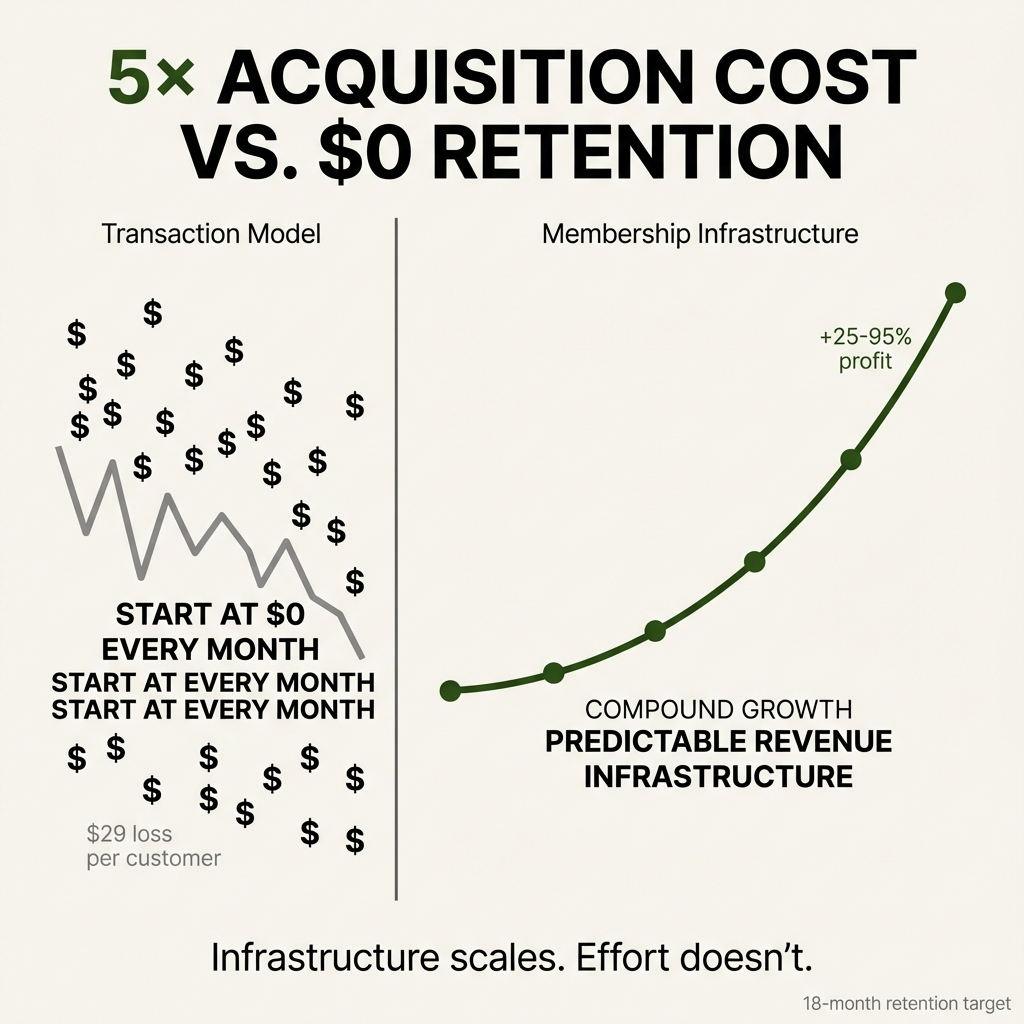
Customer acquisition costs 5x more for one-time jobs than retaining existing members
Subscription businesses grow revenue 4-8x faster than transaction-based models
A 5% increase in retention boosts profits by 25-95%
Members generate $1,188 yearly versus $300 one-time revenue
Preventive maintenance saves $5 for every $1 spent versus reactive repairs
Why One-Time Detailing Jobs Cost More Than You Think
Detailers with exceptional skills and strong work ethic still struggle financially. The reason isn't effort or quality.
The problem is infrastructure.
You're running a transaction business when you need a systematic revenue model.
What Does Customer Acquisition Actually Cost?
Acquiring a new customer costs five times more than keeping an existing one.
Every one-time detail burns money on acquisition without capturing lifetime value.
Automotive industry data shows loyal customers spend 33% more than new customers. They require less outreach, convert faster, and refer others.
Your cost per lead drops as your infrastructure matures.
Companies with subscription models grow revenue 4-8x faster than traditional counterparts. This isn't theory. This is measured outcome across industries making the shift from transactional chaos to systematic predictability.
Bottom line: Transaction-based detailing burns acquisition budget without building long-term customer value.
How One-Time Details Fail Your Clients
A one-time detail delivers short-term results with long-term problems.
The detail looks great for three weeks. Then environmental damage begins. Bird droppings, tree sap, road salt, UV exposure, and contaminants bond to the clear coat.
Your client faces two options: let the vehicle deteriorate or spend $200-$500 on restoration work that preventive maintenance would have avoided.
What Does Preventive Maintenance Actually Prevent?
Preventive maintenance delivers 48.5% lower unplanned downtime and 63.2% fewer defects compared to reactive approaches.
This manufacturing data applies directly to vehicle care. Each dollar spent on preventive maintenance saves an average of $5 on expensive restoration later.
One-time details position you as the expensive fix. Memberships position you as the systematic solution.
Your clients need maintenance infrastructure, not rescue services.
Key insight: Preventive care costs less and preserves more value than reactive repairs.
How Much Does Transaction-Based Detailing Cost You?
Transaction models create recurring expenses without recurring revenue.
You pay for ads, respond to inquiries, send quotes, schedule appointments, handle no-shows, and chase payments.
Next month starts from zero. You repeat the cycle.
The average brand loses $29 per newly acquired customer in 2026. Transaction models aren't inefficient. They're loss-leading activities.
Subscription customers deliver higher Lifetime Value while reducing monthly acquisition pressure.
Real talk: Transaction models convert predictable effort into unpredictable income. Membership models convert systematic infrastructure into predictable revenue.
What Are The Financial Benefits of Membership Models?
The math transforms detailing economics.
One-time customer: $300 total revenue.
Membership customer at $99/month: $1,188 yearly, $3,564 over three years.
The difference isn't revenue alone. Your cost structure changes completely.
Increasing customer retention by 5% boosts profits by 25-95%.
This happens because acquisition costs get amortized across longer relationships while operational efficiency increases through predictable scheduling.
Essential point: Membership revenue compounds while transaction revenue resets monthly.
How Does Customer Retention Impact Profitability?
Membership economics work differently than most detailers expect.
Members of loyalty programs generate 12-18% more revenue annually than non-members. Top programs boost revenue 15-25% per customer yearly.
You're building a customer base that spends more, refers more, and costs less to serve.
Service-loyal customers are twice as likely to make their next major purchase from the same provider.
Your detailing membership becomes the entry point for ceramic coating upgrades, paint correction services, and interior restoration work.
The infrastructure you build determines whether you capture this additional revenue.
The pattern: Retained customers spend more over time while costing less to serve.
How Should You Position Preventive Care vs. Reactive Repairs?
Positioning determines whether customers view memberships as expenses or investments.
Most detailers lead with service features: "Monthly wash and wax for $99."
This creates commodity positioning. You compete on price against every similar detailer.
Lead with the problem you prevent, not the service you provide.
The positioning shift looks like this:
"Paint correction costs $800-$1,500 when contaminants bond to your clear coat. Our maintenance program prevents that damage for $99/month. You save $600-$1,200 yearly while maintaining show condition."
You're selling damage prevention infrastructure, not detailing services.
Positioning rule: Problem prevention beats service features every time.
What Are The Best Membership Pricing Tiers?
Businesses offering three distinct pricing tiers see 30% higher subscription adoption rates than those offering one or two options.
Different vehicles require different care levels. Your tier structure should reflect this.
Basic Tier ($79-99/month): Monthly exterior maintenance wash, tire dressing, window cleaning. Prevents contamination buildup and maintains existing protection.
Premium Tier ($149-179/month): Everything in Basic plus interior vacuum and wipe-down, wheel cleaning, spray sealant application. Maintains both exterior and interior condition.
Elite Tier ($249-299/month): Everything in Premium plus monthly paint decontamination, quarterly ceramic boost application, priority scheduling, and one annual interior detail. Complete preservation system.
These tiers aren't arbitrary. They match actual vehicle needs and owner priorities.
Daily drivers in harsh climates need Elite. Weekend cars in garages maintain well with Basic. Work trucks hauling equipment need Premium interior care.
You're matching infrastructure to requirement, not upselling.
Tier strategy: Three options increase conversions by giving customers control while guiding them to appropriate service levels.
What Retention Strategies Reduce Marketing Costs?
Retention means building systems that make leaving irrational, not preventing cancellations.
44% of subscription cancellations happen within the first 90 days. Your retention infrastructure must operate from day one.
Critical window: The first 90 days determine whether members stay or leave.
What Onboarding Sequence Prevents Early Churn?
Here's the onboarding sequence that works across client implementations:
Day 1: Welcome message explaining what happens next, when to expect first service, how to reschedule if needed.
Day 3: Educational content about what maintenance prevents (with before/after photos of damage that develops without regular care).
Day 7: First service completion with photo documentation showing work performed and current vehicle condition.
Day 14: Check-in message asking about satisfaction and explaining what to expect in month two.
Day 30: Second service with comparison photos showing how condition is being maintained versus typical deterioration.
You're building the habit while demonstrating value before they question usage frequency.
51% of consumers cancel subscriptions because they're "not using it enough."
Disengagement kills retention faster than pricing issues.
Onboarding truth: Demonstrating value early prevents the "not using enough" objection before it forms.
How Do You Keep Members Engaged Long-Term?
Annual subscriptions maintain 28% retention versus only 3% for weekly billing after one year.
Longer commitment structures create stability when you deliver consistent value.
Your engagement system operates automatically:
Automated scheduling: Members receive appointment reminders and can reschedule through simple link. No back-and-forth messaging required.
Photo documentation: Every service includes before/after photos sent to member's email. Creates visual proof of ongoing value.
Condition tracking: Monthly photos build a timeline showing how protection is maintained versus typical deterioration patterns.
Upgrade triggers: When photos reveal issues (swirl marks developing, protection wearing thin), automated message suggests appropriate upgrade service.
The system creates engagement without requiring constant attention.
Engagement principle: Automated systems maintain member value perception between services.
Why Does Flexibility Prevent Cancellations?
Subscription businesses offering flexible pause or skip options reduce churn by 11-20%.
Members travel. They face budget fluctuations. They experience temporary circumstances making monthly service impractical.
Build pause options into your infrastructure instead of forcing cancellations.
The mechanism works like this: Members pause for up to two months yearly without losing membership status or pricing. They notify you through automated system, pause activates, and membership resumes when ready.
You retain the customer relationship instead of losing them permanently.
70% of would-be cancelers reconsider when offered loyalty incentives or flexibility options.
Flexibility wins: Accommodating temporary circumstances prevents permanent losses.
What Do Successful Membership Businesses Look Like?
Top-performing subscription companies maintain churn below 3% monthly. Average churn sits at 5.3%.
The difference between these numbers is systematic retention infrastructure versus hoping customers stay because they like you.
Companies generate 65% of their business from existing customers, who spend an average of 67% more than new customers.
Your membership base becomes your primary revenue source. New customer acquisition feeds growth instead of sustaining survival.
Business model shift: Transaction dependence converts to infrastructure dependence.
What Timeline Should You Expect for Transformation?
Mobile detailers should target 15% subscription penetration in year one and aim for 40% by 2030 to secure predictable cash flow.
This is the measured trajectory of service businesses transitioning from transactional to systematic models.
Your Lifetime Value needs to be at least 3x greater than your Customer Acquisition Cost. At $500 CAC (typical for service businesses running paid ads), you need $1,500 minimum LTV.
A member staying 18 months at $99/month generates $1,782 in revenue. That's your target retention duration.
Everything in your system should optimize for hitting that 18-month threshold where the economics become undeniable.
Timeline reality: Membership models take 12-18 months to show full economic impact.
What Infrastructure Do You Need to Build?
You can't manually manage membership retention while delivering services.
Detailers who succeed with memberships install systems that operate whether they're present or not.
Automated billing: Handles payment processing, failed payment recovery, and receipt delivery.
Scheduling infrastructure: Sends reminders, accepts reschedules, and maintains appointment calendar.
Communication sequences: Delivers onboarding, education, and engagement content on schedule.
Photo documentation workflow: Captures, organizes, and delivers service proof automatically.
Software companies recovered over $155 million through automated recovery tools like intelligent retries and dunning workflows in 2025. That recovered revenue counts as "pure EBITDA" because no additional acquisition cost is required.
Your membership infrastructure captures revenue that transaction models lose to payment failures and customer disengagement.
Infrastructure truth: Systems operate 24/7 without your presence. Effort scales linearly while infrastructure scales exponentially.
How Do Memberships Convert Chaos to Predictability?
Recurring revenue models provide predictable cash flow allowing businesses to forecast income accurately while reducing delayed payment risk.
You're building systematic infrastructure, not a detailing business with memberships added on.
This creates an infrastructure where revenue becomes predictable, costs become manageable, and growth becomes possible because you're not starting from zero every month.
A good recurring revenue rate sits above 15%. Higher rates indicate more sustainable business futures and reduced dependence on constant new customer acquisition.
You're converting from hope-dependent randomness to infrastructure-dependent predictability.
The question isn't whether memberships work. The data proves they do.
The question is whether you'll build the infrastructure required to make them work systematically instead of manually managing retention through constant effort.
Effort doesn't scale. Infrastructure does.
Final truth: Predictability comes from systems, not effort. Infrastructure creates the business foundation that effort alone can't build.
Frequently Asked Questions
How much should I charge for a detailing membership?
Pricing depends on your market and service level. Basic tiers typically run $79-99/month for exterior maintenance. Premium tiers with interior service range $149-179/month. Elite tiers with paint decontamination and ceramic boosters sit at $249-299/month. Price based on the value you prevent (damage repair costs) rather than the service you provide.
What percentage of my business should be membership revenue?
Target 15% subscription penetration in year one, aiming for 40% by year three. Businesses with recurring revenue above 15% show more sustainable futures and reduced dependence on constant acquisition. Top performers eventually generate 65% of revenue from existing members.
How do I handle members who want to cancel?
Build pause functionality into your infrastructure. Allow members to pause for up to two months yearly without losing membership status or pricing. 70% of would-be cancelers reconsider when offered flexibility options. This accommodates temporary circumstances without permanent customer loss.
What's the biggest reason members cancel?
51% of consumers cancel subscriptions because they feel they're not using them enough. Combat this through systematic onboarding and engagement. Send service photos documenting work performed, build condition timelines showing protection maintained, and demonstrate value before usage questions arise.
How long does it take to see results from a membership model?
Expect 12-18 months to see full economic impact. Your target is 18-month member retention at minimum because this is where lifetime value justifies acquisition costs. At $99/month, 18 months generates $1,782 revenue. With $500 typical CAC, you need 3x LTV to CAC ratio.
Do I need special software to run memberships?
You need automated infrastructure for billing (payment processing and failed payment recovery), scheduling (reminders and rescheduling), communication (onboarding and engagement sequences), and photo documentation (service proof delivery). Software companies recovered $155 million through automated recovery tools in 2025. Manual management doesn't scale.
How do memberships compare to one-time details for profitability?
One-time customers cost 5x more to acquire than retaining existing members. Loyal customers spend 33% more than new ones. Increasing retention by 5% boosts profits 25-95%. A membership customer at $99/month generates $1,188 yearly versus $300 one-time revenue. The cost structure transforms because acquisition costs amortize across longer relationships.
What if my market won't support membership pricing?
The issue is positioning, not market capability. Lead with problem prevention rather than service features. Frame memberships as damage prevention infrastructure that saves $600-$1,200 yearly versus reactive paint correction costing $800-$1,500. When you position as commodity service, you compete on price. When you position as prevention infrastructure, you compete on value.
Key Takeaways
Customer acquisition costs 5x more for one-time jobs than member retention. Transaction models burn acquisition budgets without capturing lifetime value.
Membership customers generate $1,188 yearly versus $300 one-time revenue. Over three years, this gap reaches $3,564 per customer.
A 5% increase in retention boosts profits 25-95% because acquisition costs amortize across longer relationships while operational efficiency increases.
44% of subscription cancellations happen in the first 90 days. Systematic onboarding with photo documentation and value demonstration prevents early churn.
Three-tier pricing structures see 30% higher adoption rates than single-tier offerings. Tiers should match vehicle needs: Basic for weekend cars, Premium for daily drivers, Elite for harsh climates.
Flexibility prevents cancellations. Businesses offering pause options reduce churn 11-20%. Allow two-month yearly pauses to accommodate temporary circumstances without permanent losses.
Infrastructure scales while effort doesn't. Automated billing, scheduling, communication, and documentation systems operate 24/7 without your presence, capturing revenue that manual management loses.