
Why Fleet Clients Are the Infrastructure Play Most Detailers Miss
TL;DR: Fleet contracts create predictable infrastructure for detailing businesses while retail clients generate random transactions. Monthly retainer-based fleet maintenance provides systematic revenue, operational efficiency, and competitive moats through operational integration. The key is selecting committed fleet managers who value reliability over lowest price.
Core Answer:
Fleet contracts install systematic revenue infrastructure, not random transactions
B2B trust is low (only 8% openly trust business promises), making reliability your competitive advantage
Fleet vehicle visibility generates 30,000-70,000 daily impressions at $0.15 per thousand (vs. $21 for online ads)
Monthly retainers eliminate feast-famine cycles and provide forecastable income
Operational integration creates switching costs independent of contractual obligations
I've spent months analyzing what separates detailers stuck in feast-famine cycles from those running predictable operations.
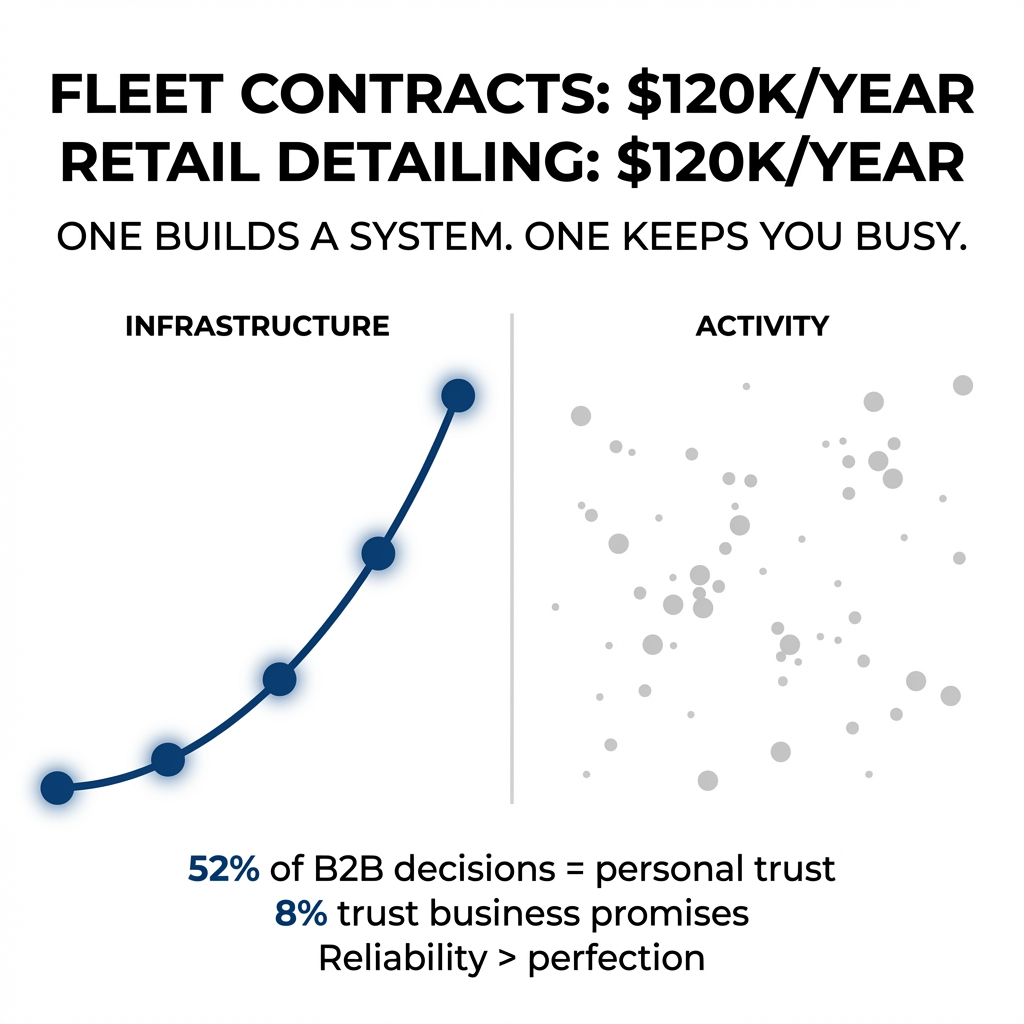
The pattern keeps repeating: fleet contracts create infrastructure. Everything else creates activity.
This isn't about working harder or finding more customers. Certain client types install systematic revenue into your business. Others generate random transactions.
How Trust Influences B2B Fleet Decisions
B2B buying has changed. Personal decision drivers now outweigh professional ones for the first time. 52% of influence comes from personal factors. Only 48% comes from traditional elements like price.
The top three decision drivers are trust-related: "I feel safe signing a contract with them," "Is known as being a good employer," "Active thought leaders."
Your professional appearance signals credibility before you speak.
Only 8% of B2B buyers openly trust business promises. In contrast, 42% trust peer opinions when making purchase decisions.
This creates a problem for detailers targeting commercial accounts. You're fighting institutional distrust before presenting your first proposal.
Bottom line: Trust determines B2B decisions more than price because personal factors now outweigh professional ones. Only 8% of buyers trust business promises.
What Fleet Managers Prioritize Over Price
Fleet managers differ from retail customers in one specific way.
They don't care about your Instagram following. They don't want to hear about your passion for perfection. They're optimizing for predictable expense ratios with zero operational disruption.
Fleet owners want clean trucks at reasonable expense. Once set up, fleet work becomes a reliable source of income. These customers are repeat clients you see weekly or biweekly.
Downtime negatively impacts their business. Lost revenue follows. Clients become dissatisfied. Therefore, reliability becomes your competitive advantage, not detailing skill.
Fleet managers have dealt with service providers who start strong but fail to maintain consistent quality. They don't care for hype. They want straightforward reliability.
This creates an opening for detailers willing to build infrastructure instead of chasing individual jobs.
Key insight: Fleet managers prioritize reliability and zero disruption over lowest price because downtime costs more than service investment.
How Fleet Vehicle Visibility Generates Marketing ROI
Most detailers treat fleet work as volume business requiring price compression.
They're missing the compounding visibility mechanism.
A single vehicle wrap generates 30,000 to 70,000 daily impressions depending on traffic and location. A modest fleet delivers millions of brand views monthly at a fraction of traditional advertising costs.
Fleet graphics cost $0.15 per thousand impressions. Online ads cost $21 per thousand impressions. Therefore, fleet graphics provide a 140x cost advantage.
97% of people remember ads placed on commercial vehicles. Only 19% remember traditional billboards.
When you maintain a fleet's appearance, you're not cleaning vehicles. You're maintaining a visibility system operating independent of the fleet owner's active marketing effort.
This changes the value proposition entirely.
The numbers: Fleet vehicle advertising generates 30,000-70,000 daily impressions at $0.15 per thousand (vs. $21 for online ads), with 97% recall rates.
Why Fleet Volume Work Commands Premium Pricing
The assumption: fleet work requires racing to the bottom on price because you're competing on volume.
This treats all volume the same.
Fleet contracts represent systematic infrastructure installation, not transaction multiplication. You're not selling more of the same service. You're installing a predictable maintenance system eliminating decision-making friction.
Fleet owners expect personalization and services tailored to their needs. Delivery times. Personalized updates. When you go the extra mile, you differentiate yourself from competitors.
86% of B2B buyers value experience more than product and pricing. They're willing to pay more for better experience. A professionally maintained fleet signals the owner delivers premium experiences, not commodity services.
Your pricing should reflect the infrastructure value you're installing:
Predictable scheduling that eliminates operational disruption
Consistent quality that maintains professional brand perception
Systematic documentation and reporting
Flexibility for urgent needs without chaos pricing
Single point of contact eliminating coordination friction
These elements justify premium positioning because they solve the actual problem fleet managers face: operational unpredictability.
What this means for you: Fleet volume doesn't require commodity pricing when you're installing infrastructure that eliminates operational unpredictability and decision fatigue.
How Monthly Retainers Create Predictable Revenue
Only 13% of consultants use monthly retainers despite their potential.
Most service providers miss this approach to business stability.
Retainer contracts provide predictable revenue where the client pre-pays for work. Finances become predictable. Revenue becomes stable. This is the biggest benefit of retainer contracts.
With retainer agreements, you forecast revenue more accurately than other pricing strategies. Being paid continuously lets you focus on clients' needs. You spend less time looking for new clients and writing proposals.
Retainers ensure steady cash flow. No relying on sporadic one-off projects.
Long-term agreements encourage deeper collaboration with clients. This leads to better results and stronger relationships.
For detailers, this means structuring fleet contracts as monthly retainers covering a defined scope of services. Not per-vehicle transactions. You're selling systematic maintenance infrastructure, not individual detail jobs.
Key point: Monthly retainers convert unpredictable project-based income into forecastable systematic revenue, letting you focus on delivery instead of constant client acquisition.
What Fleet Infrastructure Looks Like in Practice
Fleet contracts function as infrastructure in five ways:
Predictable scheduling. You know exactly which vehicles need service when. No more calendar chaos or last-minute scrambling.
Consistent cash flow. Monthly retainer payments arrive independent of service delivery timing. You're paid for availability and systematic execution, not individual completions.
Reduced acquisition cost. Once you land a fleet contract, you're not constantly hunting for the next customer. Your marketing effort shifts from acquisition to retention.
Operational efficiency. You optimize your process for the same vehicle types, same service scope, same location patterns. Efficiency compounds over time.
Expansion opportunity. Fleet owners talk to other fleet owners. One solid relationship creates referral infrastructure within specific industries.
This differs from retail detailing where every customer represents a new acquisition cost, new scheduling negotiation, new service scope discussion, and new payment collection effort.
Reality check: Fleet contracts convert per-customer acquisition cycles into one-time setup with continuous systematic execution.
How to Select the Right Fleet Clients
You can't build infrastructure with clients who treat you as interchangeable vendors.
Fleet contracts work when you select for commitment signals, not financial capacity alone.
Look for fleet managers who:
Understand that downtime costs more than service investment
Value consistency over one-time perfection
Make decisions based on operational impact rather than lowest bid
Communicate specific scheduling and quality requirements
Demonstrate respect for your operational constraints
Avoid fleet opportunities where:
Price is the only discussed variable
They're constantly switching providers
They expect immediate availability without scheduling structure
They externalize all operational problems to service providers
They treat contracts as month-to-month experiments rather than partnerships
The wrong fleet client creates chaos, not infrastructure.
Selection rule: Commitment signals matter more than financial capacity because infrastructure requires partnership, not vendor-client transactions.
Why Retail Detailing Doesn't Scale
Retail detailing faces a fundamental scaling problem: you're always starting from zero with each customer.
Every new client requires the full acquisition cycle. Every service delivery is a unique negotiation. Every payment is a separate transaction. Every scheduling request is a new coordination effort.
This creates activity without infrastructure.
Fleet contracts invert this pattern. The acquisition effort happens once. The service scope is defined systematically. The payment structure is predictable. The scheduling follows established patterns.
You're building a system that operates independent of constant operator involvement.
This is what infrastructure looks like: installed once, functioning continuously, generating outcomes without requiring moment-to-moment decision-making.
The contrast: Retail detailing multiplies activity. Fleet contracts install infrastructure. Activity consumes time. Infrastructure generates outcomes systematically.
How Fleet Contracts Create Competitive Moats
Most detailers compete on execution quality or price.
Both are replicable.
When you install systematic fleet maintenance infrastructure, you're building a different kind of competitive advantage:
Operational integration. Your service becomes embedded in their business operations. Switching providers means operational disruption, not just vendor replacement.
Relationship depth. Monthly interaction builds trust that one-time transactions can't match. You understand their specific needs, vehicle conditions, and operational constraints.
Process optimization. You've refined your approach specifically for their fleet. A new provider starts from zero on the learning curve.
Systematic documentation. You maintain records of service history, specific vehicle issues, and seasonal patterns. This knowledge becomes irreplaceable.
This creates switching costs independent of contractual obligations. The costs come from operational reality.
Why this matters: Operational integration creates defensibility through embedded dependency, not contractual lock-in.
What Changes When You Make This Shift
The transition from transaction-based retail to infrastructure-based fleet work changes your entire operational reality.
Your calendar becomes predictable. You know what's happening next week, next month, next quarter.
Your revenue becomes forecastable. You can make business decisions based on systematic income rather than hopeful projections.
Your marketing effort shifts from constant acquisition to strategic retention and targeted expansion.
Your operational efficiency compounds as you optimize for repeating patterns rather than unique circumstances.
Your client relationships deepen because you're solving ongoing operational problems rather than delivering isolated services.
This is what systematic business construction looks like.
It's not about working harder or finding more customers. It's about recognizing which client types install infrastructure into your business and which ones generate random activity.
Fleet contracts are infrastructure. Retail transactions are activity.
The difference determines whether you're building a system or just staying busy.
Frequently Asked Questions
How do I transition from retail to fleet clients without losing current revenue?
Start with one fleet client while maintaining retail work. Structure the fleet contract as a monthly retainer covering defined services. Once the first fleet relationship proves stable (3-6 months), target a second fleet client. The retainer model provides predictable base revenue, letting you phase out retail gradually rather than abruptly.
What size fleet should I target when starting out?
Start with fleets of 5-15 vehicles. Smaller fleets provide manageable complexity while you refine your systematic approach. Larger fleets require more operational infrastructure before you're ready. Once you've optimized processes with smaller fleets, scale to larger ones.
How do I price fleet contracts without undervaluing my services?
Price based on infrastructure value, not per-vehicle cost. Calculate: predictable scheduling value, operational efficiency from repeating patterns, reduced marketing costs, systematic documentation benefits, and flexibility premium. Your price should reflect the operational unpredictability you're eliminating, not cleaning time alone.
What if fleet managers only want to talk about price?
Price-focused conversations indicate wrong-fit clients. Fleet managers who understand operational costs recognize downtime costs more than service investment. When price is the only variable discussed, the relationship will create chaos, not infrastructure. Select for commitment signals instead.
How long does it take to land a fleet contract?
Fleet sales cycles run 30-90 days because fleet managers make operational decisions, not impulse purchases. They're evaluating reliability, not looking for deals. Expect multiple conversations, proof of systematic approach, and references. The longer cycle filters for committed clients.
Should I offer discounts for volume to win fleet contracts?
No. Volume discounts signal commodity positioning. You're not selling more of the same service. You're installing infrastructure eliminating decision-making friction and operational unpredictability. Price should reflect systematic value, not transaction volume.
What happens if a fleet client cancels after a few months?
Early cancellation indicates selection failure, not service failure. Review commitment signals during onboarding. Did they value consistency over price? Understand downtime costs? Demonstrate respect for your constraints? Wrong-fit clients reveal themselves through month-to-month thinking rather than partnership orientation.
Can I serve multiple fleet clients in different industries?
Yes, with caveat. Different industries require different service approaches (construction vehicles versus delivery vans). Operational efficiency compounds when you serve similar fleet types. Start with one industry vertical, optimize your approach, then expand to adjacent verticals once systematic processes are proven.
Key Takeaways
Fleet contracts install systematic revenue infrastructure while retail transactions generate random activity requiring constant acquisition effort.
B2B trust is low (8% openly trust business promises), making reliability and operational integration your primary competitive advantages over price or execution quality.
Fleet vehicle visibility generates 30,000-70,000 daily impressions at $0.15 per thousand impressions (140x cheaper than online ads with 97% recall rates).
Monthly retainer structures convert unpredictable project income into forecastable systematic revenue, eliminating feast-famine cycles.
Client selection matters more than sales volume. Commitment signals (valuing reliability over price, understanding downtime costs) determine infrastructure viability.
Operational integration creates switching costs through embedded dependency, not contractual obligations. Fleet managers resist changing providers because of operational disruption.
Fleet contracts scale through systematic replication while retail detailing scales through activity multiplication. Infrastructure compounds efficiency while activity consumes time.