
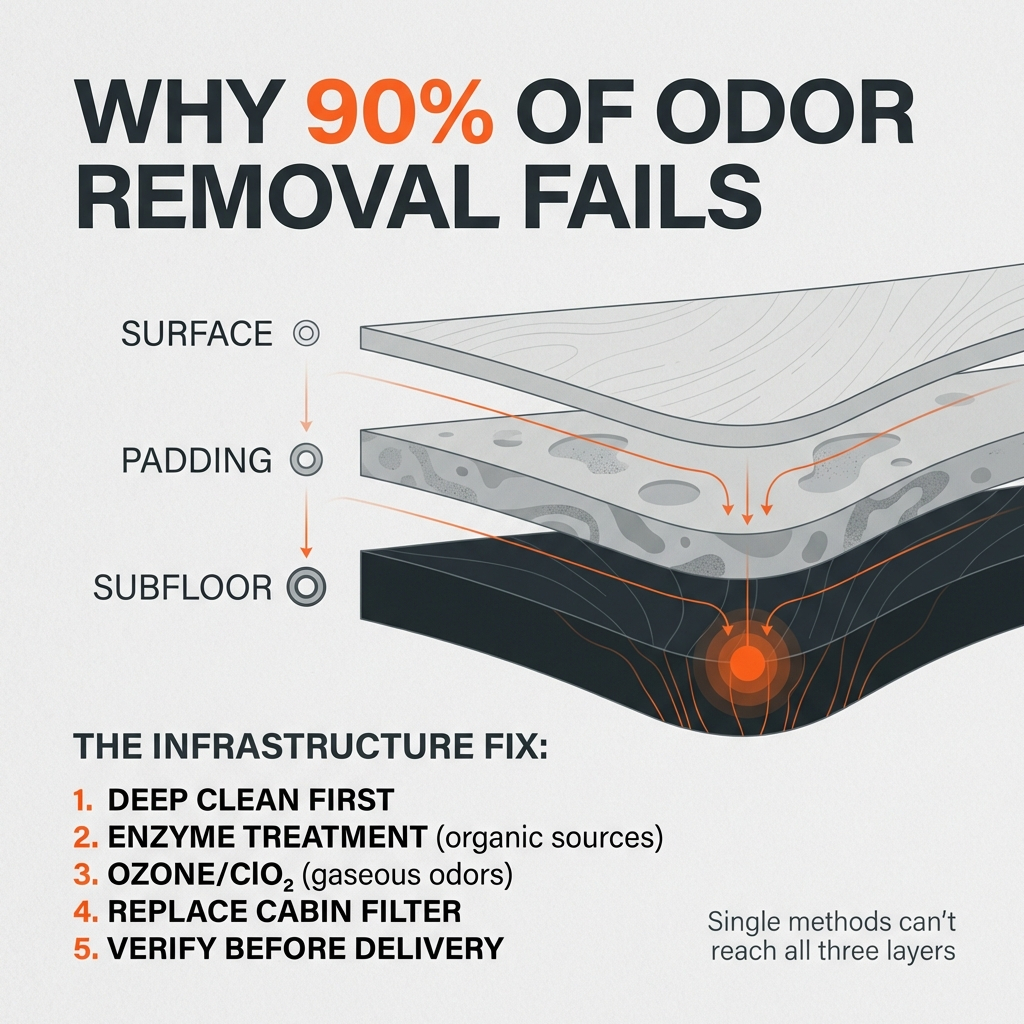
Why Most Odor Removal Fails: The Infrastructure Truth About Smoke and Pet Smells
TL;DR: Odor removal fails when treated as cleaning instead of infrastructure. Ozone works for airborne molecules but cannot penetrate deep into padding. Enzymes digest organic materials in fabric. Complete elimination requires both methods, cabin filter replacement, and honest pricing tiers. Used car dealers need reliable systems, not commodity services.
Quick Answer: Why Odor Removal Fails
Ozone gas cannot fully penetrate carpet padding, headrests, or seat stuffing where odors hide
Single-method approaches leave contamination in cabin air filters and porous materials
Heat reactivates dormant odor crystals weeks after apparent cleaning success
Masking overwhelms smells temporarily; neutralization changes molecular structure permanently
Complete removal requires systematic multi-method infrastructure, not faster cleaning
What Makes Ozone Treatment Incomplete
Ozone treatment has real limitations. No one guarantees complete effectiveness because the gas cannot fully penetrate materials.
I watched detailers promise guaranteed results with ozone alone. Customers returned three weeks later when Arizona heat reactivated smells.
Odor elimination fails when you treat it as cleaning instead of infrastructure.
Bottom line: Ozone handles airborne odors but misses embedded contamination in porous materials.
How Odors Penetrate (And Why Your Treatment Must Match)
Infrastructure thinking starts with penetration patterns.
Smoke creates odor by penetrating fabrics, surfaces, and materials. Your deodorizing method must follow the same path. Animal urine floods carpet and padding. You need to flood those areas with deodorizing chemicals.
The reality: one drop of deodorant near the spot cannot neutralize deep contamination.
I learned this after my first smoke removal failed. Two hours of ozone treatment. Customer left happy. Four days later, they called back. The smell returned.
I missed the infrastructure component.
The cabin air filter.
Smoke blows through air vents and filters. The cabin air filter gets coated in tar, nicotine, and smoke molecules. Even after removing every trace from the interior, that filter reintroduces smell when customers turn on the AC.
This is systematic thinking. Find the infrastructure failure points that commodity providers ignore.
Key insight: Your treatment method must match how the odor originally penetrated the vehicle.
Ozone vs Enzymes: What Each Method Actually Does
You need both methods.
How Ozone Treatment Works
Ozone generates O₃ gas that oxidizes odor molecules. Seal the vehicle. Run the generator for 30 minutes to several hours. The ozone reacts with odor particles to change their molecular structure.
Ozone advantages:
Penetrates air ducts and hidden spaces
Works on gaseous odor sources like smoke
Reaches areas physical cleaning cannot access
Ozone limitations:
Damages interior materials with overexposure
Poses health risks without proper ventilation
Struggles with organic material embedded in porous surfaces
How Enzymatic Treatments Work
Enzymes digest organic materials at the molecular level. This matters for pet odors because urine contains uric acid crystals that standard cleaning cannot eliminate.
These crystals reactivate when exposed to moisture or heat. Arizona heat hits 150°F inside vehicles during summer. Dormant crystals wake up and spread throughout the cabin.
Enzymes excel in porous, organic materials like fabric and carpet. Ozone and chlorine dioxide dominate in air and on hard surfaces.
You need both for complete coverage.
The takeaway: Ozone handles airborne molecules; enzymes digest embedded organic contamination.
Masking vs Eliminating: Why This Distinction Drives Customer Satisfaction
Most customers don't know how to explain the difference between masking and elimination.
They know when the smell comes back.
What Masking Does
Masking does not alter the molecular structure of malodors. It overwhelms those molecules with pleasant-smelling molecules. The problem: mixing compounds creates new nuisance odors.
What Neutralization Does
Neutralization removes odor molecules through chemical reaction. Effective neutralization changes the molecular structure of the malodor compound.
The financial impact extends beyond detailing. A foul-smelling restroom in a restaurant means significant business loss. Consumer reviews turn negative after malodorous experiences.
Persistent car odors reduce resale value by thousands of dollars. Buyers reject cars with odor problems immediately, regardless of mechanical condition or appearance.
This creates your value proposition for used car dealers.
Remember: Masking provides temporary relief; neutralization provides permanent molecular change.
The Used Car Dealer B2B Opportunity (And What Nobody Tells You)
Dealership contracts have real opportunities and real drawbacks.
Why Dealerships Need Odor Removal
Partnering with dealerships provides consistent revenue and growth. You get volume. You get predictable work. You get exposure to inventory needing odor elimination before hitting the lot.
What Dealerships Will Do
Dealerships terminate contracts at any notice. They haggle on price constantly. You have less control over quality standards compared to direct consumer work.
Pricing structures range from $70 per vehicle with 10-per-week minimums. That's $700 weekly guaranteed, but you're locked into volume commitments during peak season.
The Infrastructure Investment Required
You need ozone generators. You need enzymatic treatments. You need systematic processes that handle smoke removal in four to six hours per vehicle, including prep and treatment.
The Dealership Decision Context
Auto dealers struggle with whether to run in-house detail departments or hire outside shops. Those who choose in-house want better control and quality. Those who contract out want to eliminate management problems, unreliable employees, and high volume costs.
Detail shops face turnover rates as high as 75 percent yearly. This creates inconsistent quality and unreliable service delivery.
Your differentiation lives in this gap. You're not offering commodity detailing. You're installing systematic odor elimination infrastructure that produces replicable outcomes no matter which technician runs the process.
Core truth: Dealerships need reliability more than low prices because odor problems kill sales.
How to Price Odor Removal (Without Destroying Your Reputation)
You cannot guarantee every case.
I learned to communicate this upfront after a customer expected complete odor removal from a vehicle where the previous owner chain-smoked for 15 years. The headliner was saturated. The carpet padding was destroyed. The door panels had absorbed nicotine into the material.
Honest positioning: you can remove smoke and odor from interiors most of the time. In extreme cases, you need to replace mats, headliner, carpet, and other components.
Outcome-contingent pricing protects both you and the customer.
Tier 1: Standard Odor Removal
Light to moderate odors from food, mildew, or brief smoke exposure. Fixed price with guaranteed satisfaction or full refund. This builds trust and demonstrates confidence in your systematic process.
Tier 2: Deep Odor Elimination
Heavy smoke or pet urine requiring multi-method treatment. Deposit plus completion payment contingent on customer approval. You share outcome risk while protecting against customers who won't invest in necessary material replacement.
Tier 3: Extreme Cases
Assessment fee to evaluate whether odor removal works without replacing interior components. If replacement is necessary, provide cost breakdown before proceeding. If treatment alone works, apply the assessment fee toward the service.
This structure eliminates reputation damage from overpromising. You're not claiming universal success. You're demonstrating systematic methodology with honest boundaries.
Pricing principle: Share outcome risk in proportion to odor severity and material condition.
The Complete Multi-Method System (Step by Step)
Single methods fail because odors hide in different locations with different material properties.
The Infrastructure Sequence
Step 1: Deep Clean the Entire Interior
Headliner, seats, carpets, vents, door panels, trunk. Remove surface contaminants and prepare materials for treatment penetration.
Step 2: Apply Enzymatic Treatment to Organic Odor Sources
Flood affected areas with enzyme solution. Let it dwell for manufacturer-specified time. Enzymes need contact time to digest uric acid crystals and organic compounds.
Step 3: Deploy Ozone or Chlorine Dioxide Treatment
Seal the vehicle. Run the generator for appropriate duration based on odor severity. This handles gaseous odors and reaches spaces enzymatic treatment cannot access.
Step 4: Replace Cabin Air Filter
This is infrastructure, not optional. The filter holds contamination that reintroduces odors the moment customers use climate control.
Step 5: Verify Elimination Before Customer Pickup
Let the vehicle air out completely. Test with fresh perspective or someone who wasn't involved in treatment. Your nose adapts to smells during extended exposure.
Time Investment Reality
Smoke removal typically runs four to six hours. Pet urine takes longer depending on penetration depth into padding and subflooring.
You cannot shortcut this process without compromising outcomes.
System rule: Complete each step before moving to the next; skipping steps guarantees failure.
Why Infrastructure Beats Activity Every Time
Most detailers optimize for getting cars out the door.
I optimize for outcome replication.
The difference shows when customers refer others specifically for odor elimination. They don't say "get your car detailed." They say "this person removes smells other detailers couldn't fix."
That positioning comes from systematic infrastructure, not from working faster or cheaper.
You're not competing on price when you solve problems commodity services don't address. You compete on outcome production. Outcomes require infrastructure most detailers won't buy because they optimize for different metrics.
Cabin air filter replacement alone separates you from 90 percent of competitors. The multi-method approach eliminates another 8 percent. Honest communication about extreme cases requiring material replacement builds trust that "we fix everything" promises destroy.
This builds a detailing service that generates referrals instead of needing constant marketing to replace customers who got mediocre results.
Infrastructure comes before activity. The system sets outcome boundaries. Proof comes from replicable results, not from promises about what should work in theory.
That's how I build something sustainable in a market full of commodity providers making identical claims.
Frequently Asked Questions
How long does ozone treatment take to remove smoke smell?
Ozone treatment runs 30 minutes to several hours depending on odor severity. Total smoke removal takes four to six hours including deep cleaning, enzymatic treatment, ozone generation, and cabin filter replacement. Ozone alone leaves contamination in filters and porous materials.
Will pet urine smell come back after cleaning?
Yes, if you only surface clean. Urine contains uric acid crystals that reactivate with heat or moisture. Arizona heat reaches 150°F inside vehicles, waking dormant crystals weeks after cleaning. Enzymatic treatment digests these crystals at the molecular level to prevent reactivation.
When should you replace interior components instead of treating odors?
Replace components when materials are saturated beyond treatment capacity. Examples include 15-year chain-smoker vehicles with saturated headliners, destroyed carpet padding, or door panels absorbed with nicotine. Assess before quoting to set honest expectations.
What is the difference between masking and neutralizing odors?
Masking overwhelms malodors with pleasant-smelling molecules without changing odor structure. The smell returns when masking agents dissipate. Neutralization changes the molecular structure through chemical reaction, permanently eliminating the odor source.
Do you need both ozone and enzymatic treatments?
Yes, for complete coverage. Ozone handles airborne molecules and penetrates air ducts but struggles with organic material in porous surfaces. Enzymes digest organic compounds in fabric and carpet but cannot reach gaseous odors. Each method covers what the other misses.
Why does smoke smell return after ozone treatment?
The cabin air filter holds tar, nicotine, and smoke molecules. Even after removing interior odors, the filter reintroduces smell when customers use climate control. Replace the cabin filter as infrastructure, not as an optional step.
How do you price odor removal for used car dealers?
Structure three tiers. Tier 1 for light odors at fixed price with satisfaction guarantee. Tier 2 for heavy contamination with deposit plus completion payment. Tier 3 assessment fee for extreme cases to evaluate viability before committing to treatment or replacement.
What makes odor removal different from regular detailing?
Regular detailing cleans surfaces. Odor removal requires infrastructure thinking to match how contamination originally penetrated materials. This means multi-method treatments, filter replacement, and systematic processes that produce replicable outcomes instead of hoping surface cleaning works.
Key Takeaways
Ozone penetrates air and ducts but cannot reach deep contamination in padding, headrests, or seat stuffing where odors hide.
Enzymes digest organic materials like uric acid crystals that reactivate with heat, preventing smell from returning weeks later.
Cabin air filter replacement is infrastructure requirement, not optional, because filters reintroduce contamination through climate control.
Masking provides temporary relief by overwhelming odors; neutralization permanently changes molecular structure through chemical reaction.
Three-tier pricing protects reputation by matching guarantees to odor severity and sharing outcome risk proportional to material condition.
Used car dealers need reliability over low prices because persistent odors kill sales regardless of mechanical condition or appearance.
Infrastructure thinking means matching your treatment method to how odors originally penetrated materials, not applying generic cleaning.