
Why Your Leather Conditioner Isn't Actually Protecting Anything
TL;DR: Leather conditioners restore oils temporarily but don't create a protective barrier. Ceramic coating forms a physical shield that blocks UV radiation and heat for up to two years, preventing cracking and fading in daily drivers. Prevention costs $300-500 upfront versus $1,500+ for restoration later.
Quick Answer
Conditioning products feed leather with oils but leave no protective barrier against UV and heat damage
Ceramic coating creates a physical shield that lasts 1-2 years and operates during non-use periods
UV radiation and heat above 150°F cause systematic degradation in as little as 4-6 months
Once leather is structurally damaged, original properties cannot be fully restored
Interior ceramic coating costs $300-500 versus $1,500+ for restoration after damage occurs
I spent three months testing leather products on daily driver interiors in Arizona heat.
The results surprised me.
Most of what we call protection is feeding. Feeding without a barrier system means you're maintaining leather that's dying in real time.
Why Doesn't Conditioning Protect Leather?
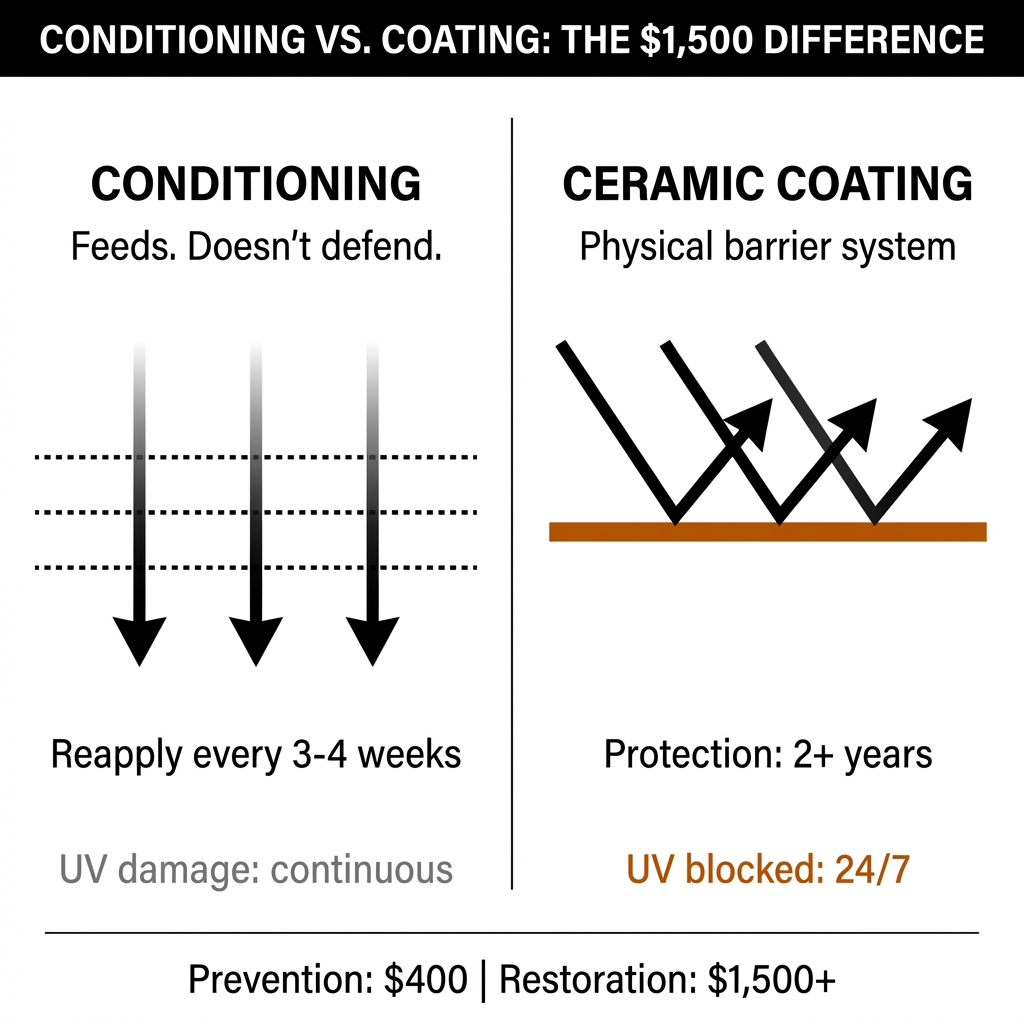
Here's what I found: conditioning products restore oils temporarily but don't create a protective barrier.
They're maintenance, not infrastructure.
Most conditioners are cream or oil-based products that soak into leather to restore oils lost from UV exposure and heat, according to West Coast Detail. The problem? These oils sit on the surface, leaving a wax residue that goes nowhere.
You're feeding the leather. You're not defending it.
In hot climates, that distinction matters more than most detailers realize.
Bottom line: Conditioning adds temporary oils but creates no protective barrier, making it maintenance rather than prevention.
What Causes Leather Damage in Daily Drivers?
The enemy isn't dirt. It's not even wear patterns from getting in and out of the car.
UV radiation and heat operate independently of your effort.
UV rays break down collagen fibers in leather. This causes loss of flexibility, strength, and color fade. Fibrenew reports you will see fading in as little as 4 to 6 months if leather is exposed to serious sunlight.
For daily drivers in hot climates, this happens in real time.
Systematic degradation happens whether you're working or not.
Heat buildup inside a closed car exceeds 150 ongF. This accelerates the breakdown of leather fibers. Heat draws moisture out of the material, causing it to dry out, crack, and warp.
Daily assault on the material.
Here's the part that changed how I approach interior protection: once the natural oils in leather are gone, they're gone for good.
You cannot restore what's structurally damaged. Once leather is faded, the only way to get color back is professional re-dyeing and color matching. Cost varies depending on size and extent of damage.
This is the difference between infrastructure installation and crisis intervention.
Bottom line: UV radiation and heat above 150°F cause irreversible damage within 4-6 months because natural oils cannot be replaced once gone.
How Does Ceramic Coating Differ From Conditioning?
I tested ceramic coating on interiors to understand the mechanical difference between conditioning and protection.
Here's what I learned.
Ceramic coating creates a physical barrier that conditioning can't replicate.
Ceramic Coat Expert reports ceramic coating offers superior durability and longevity over conditioning and waxing, providing up to two years of protection. More importantly, it makes maintenance easy while ensuring minimal dust adhesion.
This is system installation, not service repetition.
The difference shows up in how the leather responds over time. Conditioned leather requires reapplication every few weeks to maintain oil content. Ceramic-coated leather maintains its barrier independent of your presence.
It operates during non-use periods.
That's the definition of systematic leverage.
Bottom line: Ceramic coating forms a physical barrier lasting 1-2 years that works continuously, while conditioning requires reapplication every few weeks.
How Do You Apply Ceramic Coating to Interior Leather?
I'll walk you through the process I use. I've applied this to over 30 vehicles in the past four months.
Step 1: Deep Clean the Surface
Remove all existing oils, waxes, and contaminants. I use a pH-neutral leather cleaner and a soft brush to agitate the surface without damaging the grain.
Wipe with a clean microfiber towel until no residue transfers.
This step determines coating adhesion. Skip it and you're coating over contamination.
Step 2: Inspect for Damage
Look for cracks, tears, or areas where the top coat has worn through. Ceramic coating won't repair structural damage. It protects what's there.
If you find damage, address it before coating. Otherwise you're installing infrastructure on a compromised foundation.
Step 3: Apply the Coating in Thin Layers
I use a foam applicator and work in 2x2 foot sections. Apply the coating in straight, overlapping lines. You want even coverage without pooling.
Most products require 1-2 minutes of dwell time before buffing.
Buff immediately with a clean microfiber towel using light pressure. You're leveling the coating, not removing it.
Step 4: Apply a Second Layer
Wait the recommended cure time between layers. This varies by product but usually ranges from 1-4 hours.
The second layer increases durability and fills microscopic gaps from the first application.
Step 5: Allow Full Cure Time
Most ceramic coatings need 24-48 hours to fully cure. During this time, avoid contact with the surface. No sitting in the seats, no touching, no moisture exposure.
This is where most people fail. They rush the cure time and compromise effectiveness.
⚠️ Warning: Ceramic coating is permanent once cured. If you make a mistake during application, removal requires abrasion or chemical stripping. Take your time during the application phase.
Bottom line: Success requires thorough surface cleaning, damage inspection, thin even layers, a second coat, and full 24-48 hour cure time.
Is Ceramic Coating Only for Luxury Cars?
I hear this constantly: "My car isn't fancy enough for ceramic coating."
This misses the point entirely.
Interior protection isn't about luxury. It's about infrastructure that operates during non-use periods.
GardX reports interior car protection helps safeguard against wear and tear, extends vehicle lifespan, maintains resale value, and enhances driving experience.
The value proposition isn't status. It's systematic defense against inevitable degradation.
Properly applied interior protection lasts the lifetime of the car. Install once, benefit continuously.
That's not luxury thinking. That's infrastructure thinking.
Here's what most people overlook: adding interior protection to your vehicle helps maintain resale value and becomes a beneficial selling point. Premier Detailing reports a fresh, clean interior impresses potential buyers and gives them confidence the vehicle was well maintained.
Protection isn't expense. It's investment that compounds over ownership duration.
Bottom line: Interior protection is infrastructure for systematic defense and resale value, not a luxury reserved for expensive vehicles.
How Should Detailing Businesses Price Interior Ceramic Coating?
I started offering ceramic coating for interiors because I wanted to solve a structural problem, not add another service.
The structural problem: conditioning feeds but doesn't protect.
Clients come back monthly for conditioning. They're paying for maintenance that doesn't prevent the underlying degradation. They're stuck in a service cycle that generates revenue for me but doesn't solve their problem.
That's extraction, not transformation.
Ceramic coating changes the relationship. You install infrastructure once. The client benefits for years. You're not optimizing for service repetition. You're optimizing for outcome production.
This requires a different pricing model. You don't charge $50 for something that lasts two years. The value isn't in the time you spend. It's in the protection you install.
I charge $300-500 for full interior ceramic coating depending on vehicle size and leather condition. That's infrastructure pricing for systematic protection.
The clients who understand this distinction are the ones you want. They're not shopping for the cheapest conditioning. They're investing in long-term protection.
Bottom line: Infrastructure pricing of $300-500 reflects long-term protection value, not hourly labor, shifting from service repetition to outcome production.
Is Prevention Cheaper Than Restoration?
Here's the reality most detailers don't tell clients: once leather is structurally damaged, restoration is expensive and often incomplete.
You can re-dye faded leather. You can fill cracks with leather filler. You can apply coatings to hide wear patterns.
You cannot restore the original material properties.
Prevention is always cheaper than restoration. Always.
This is why I lead with ceramic coating for clients who plan to keep their vehicle longer than two years. The math is simple: $400 for coating now or $1,500+ for restoration later.
The choice is obvious when you present it as infrastructure vs. crisis intervention.
Bottom line: Prevention costs $400 upfront versus $1,500+ for incomplete restoration because structural damage cannot be fully reversed.
What Works Best Based on Real Applications?
I've applied ceramic coating to 30+ vehicle interiors in the past four months. Here's what I learned that you won't find in product marketing.
Application consistency matters more than product brand. I've used three different ceramic coating products. The results varied more based on my application technique than product chemistry.
Take your time. Work in small sections. Maintain even pressure during buffing.
Surface preparation determines longevity. The coatings that failed early all had one thing in common: inadequate cleaning before application. You're bonding to whatever is on the surface. If that surface is contaminated, your coating won't last.
Client education prevents disappointment. Ceramic coating isn't magic. It doesn't repair existing damage. It doesn't make leather invincible. It creates a barrier that slows degradation and simplifies maintenance.
Set accurate expectations during the consultation. Show them what coating can and can't do.
The second layer makes a measurable difference. I tested single-layer versus double-layer applications on similar vehicles. The double-layer applications showed noticeably better water beading and dust resistance at the six-month mark.
Don't skip the second layer to save time.
Bottom line: Application technique beats product brand, surface prep determines longevity, and double layers measurably outperform single applications.
What Is the Infrastructure Approach to Leather Protection?
I approach ceramic coating the same way I approach systematic business infrastructure: install once, benefit continuously, minimize ongoing intervention.
This mindset changes how you price, how you sell, and how you deliver.
You're not selling a service. You're installing protection infrastructure that operates independently of your presence.
That's worth more than hourly labor rates suggest.
And for clients operating in hot climates with daily drivers, it's the difference between systematic protection and repetitive repair cycles.
The leather in their car is degrading right now. UV radiation and heat don't pause when they're not thinking about it.
Conditioning slows the process. Ceramic coating creates a barrier that functions during non-use periods.
That's not luxury. That's infrastructure.
And infrastructure is what transforms commodity service delivery into systematic value creation.
Bottom line: Infrastructure thinking means installing protection once for continuous benefit, transforming service delivery into systematic value creation.
Frequently Asked Questions
How long does ceramic coating last on leather interiors?
Ceramic coating on leather interiors lasts 1-2 years with proper application. This timeframe assumes the surface was thoroughly cleaned before application and the coating received full cure time of 24-48 hours. Double-layer applications show better durability at the six-month mark compared to single layers.
Can I apply ceramic coating over conditioned leather?
No. You must remove all existing oils, waxes, and conditioners before applying ceramic coating. The coating bonds to whatever is on the surface. If you coat over contamination, adhesion fails and longevity decreases. Use a pH-neutral leather cleaner and wipe until no residue transfers to a clean microfiber towel.
Does ceramic coating repair cracked or faded leather?
No. Ceramic coating protects existing leather but does not repair structural damage. It creates a barrier that prevents future degradation. If leather is already cracked or faded, address those issues before coating. Otherwise you're installing infrastructure on a compromised foundation.
How much does interior ceramic coating cost compared to regular conditioning?
Interior ceramic coating costs $300-500 for full application versus $50-100 per conditioning session. Conditioning requires reapplication every few weeks. Ceramic coating lasts 1-2 years. Over two years, conditioning costs $1,200-2,400 while ceramic coating costs $300-500 once.
What happens if leather gets damaged after ceramic coating?
Ceramic coating prevents damage from UV radiation and heat but does not make leather invincible. Physical tears, cuts, or punctures will still occur from sharp objects. The coating protects against environmental degradation, not mechanical damage. Set these expectations during client consultations.
Can ceramic coating be removed if I make a mistake?
Yes, but removal is difficult. Once cured, ceramic coating is permanent and requires abrasion or chemical stripping to remove. This is why proper surface preparation and careful application matter. Work in small sections, maintain even pressure during buffing, and take your time.
Is ceramic coating worth it for older vehicles?
Yes, if the leather is structurally sound. Inspect for cracks, tears, or worn-through top coat before coating. If damage exists, repair it first. Ceramic coating prevents further degradation regardless of vehicle age. The infrastructure thinking applies equally to old and new vehicles.
How soon can I use my car after applying ceramic coating?
Wait 24-48 hours for full cure time. During this period, avoid all contact with coated surfaces. No sitting in seats, no touching, no moisture exposure. Rushing cure time is where most applications fail because it compromises coating effectiveness.
Key Takeaways
Conditioning restores oils temporarily but provides no protective barrier, making it maintenance rather than prevention against UV and heat damage
Ceramic coating creates a physical shield lasting 1-2 years that operates continuously during non-use periods, unlike conditioning that requires reapplication every few weeks
UV radiation and heat above 150°F cause irreversible leather damage within 4-6 months because natural oils cannot be replaced once structurally gone
Proper application requires thorough surface cleaning, damage inspection before coating, thin even layers, a mandatory second coat, and full 24-48 hour cure time without contact
Prevention costs $300-500 upfront versus $1,500+ for incomplete restoration later because structural damage cannot be fully reversed once it occurs
Interior protection is infrastructure for systematic defense and resale value, not luxury reserved for expensive vehicles
Application technique and surface preparation determine longevity more than product brand, with double layers measurably outperforming single applications at six months