
Why Your PPF Conversations Fail: The Infrastructure Problem Nobody's Solving
TL;DR: PPF conversations fail when detailers explain product features instead of financial reality. Customers need to see the rock chip repair math: $150-$400 per repair session versus $1,500-$3,000 one-time PPF investment. Show the damage pattern they're facing, demonstrate self-healing in person, and frame PPF as insurance that protects resale value. The difference between closing deals and losing them is systematic presentation infrastructure, not charisma.
PPF closes when you answer these questions:
Front-end PPF costs $1,500-$3,000 upfront and eliminates recurring $150-$400 repair costs for 7-12 years
Self-healing technology works through polymers that flow back into shape at 140-160°F, healing scratches in 30 seconds to 5 minutes
Paint damage reduces resale value by 5-10% on average, with 78% of buyers considering exterior condition critical
Partial coverage ($600-$1,200) protects high-impact areas where 90% of chips occur
Touch-up paint creates visible blobs and costs $150/hour professionally, while PPF prevents damage entirely
I've watched detailers lose PPF deals they should have won.
The conversation goes like this: Customer asks about paint protection film. You explain the benefits. They nod along. Then they say they'll think about it and never come back.
The problem isn't your pitch. You're answering the wrong question.
When someone asks about PPF, they're not asking what this product is. They're asking why they should spend money on this instead of dealing with chips later.
Most detailers answer the first question. The ones closing deals answer the second.
How Does Self-Healing PPF Work?
Most people explain self-healing PPF like this: "It has elastomeric polymers that respond to heat by rearranging their molecular structure."
Accurate. Useless.
Here's what works: "Self-healing PPF works like an ice cube. Scratch it with your fingernail and heat it up. The ice returns to its original smooth state. The film works the same way. Scratches vanish when the car sits in the sun or gets washed with warm water."
The science is simple. Self-healing PPF contains polymers that flow back into their original shape when exposed to heat between 140°F and 160°F. Minor scratches disappear within 30 seconds to 5 minutes.
You demonstrate this in your shop. Scratch a sample piece with your keys. Pour warm water over it. Watch it heal in front of them.
That demonstration closes more deals than any technical explanation.
Bottom line: Self-healing technology works through heat-activated polymers. Skip the chemistry lecture. Show the ice cube comparison and demonstrate it live.
What Does Paint Chip Repair Cost Versus PPF?
Customers don't buy PPF because they understand the product. They buy because they understand the alternative.
Here's the alternative most people don't calculate.
Professional rock chip repair costs $150 to $400 per panel. This price buys quality work that achieves 80 to 95% cosmetic improvement. Body shop respray of a single bumper runs $650 to $1,000. You'll lose your vehicle for multiple days.
The problem compounds. Paint chips left unrepaired allow water, dirt, and salt to penetrate. Minor damage eventually requires extensive repairs. Once rusting occurs, touch-up jobs stop working.
I show customers this calculation: PPF on the front end runs $1,500 to $3,000 depending on coverage. This investment eliminates repeated $150 to $400 repair sessions every time road debris strikes. Over five years, PPF reduces repair costs by 40%.
The math sells itself when you show it.
Partial PPF Coverage: The Option That Closes More Deals
Full vehicle PPF scares away practical buyers. The price tag looks like luxury car territory.
Full coverage isn't the only option.
The most common protection package covers full bumper, partial hood, fenders, and mirrors. For standard vehicles, this runs $600 to $1,200. This protects the high-impact areas where 90% of rock chips occur.
When you present this as insurance for the parts that get hit most, the conversation shifts. You're no longer selling a luxury product. You're selling practical protection with measurable ROI.
Key insight: Front-end PPF costs $1,500 to $3,000. Partial coverage costs $600 to $1,200. Both eliminate recurring $150 to $400 repair sessions. The math works for practical buyers when you show partial coverage options.
Is PPF Only for Luxury Cars?
I hear this objection constantly: PPF is for people with Porsches and Ferraris.
Branding talking. Not reality.
Road debris doesn't check your vehicle's price tag before hitting your paint. Sand blowing across freeways, highway driving, parking lot door dings create inevitable damage on any vehicle.
Some makes and models face more rock chip damage than others. The damage happens whether you're driving a Honda Civic or a Mercedes S-Class.
The difference: luxury car owners already understand paint protection as standard practice. Daily driver owners need to see the same math apply to their situation.
When you show a Civic owner that three rock chip repairs cost more than partial front-end PPF, the luxury car comparison becomes irrelevant.
The reality: PPF protects any vehicle from road debris damage. The cost comparison works for daily drivers and luxury cars. Show the math specific to their vehicle and driving pattern.
How Does PPF Protect Vehicle Resale Value?
People understand insurance. They pay for it monthly even though they hope to never use it.
PPF works the same way for paint.
Here's the resale value impact most detailers never mention.
Paint damage reduces a vehicle's resale value by 5 to 10% on average. A $20,000 car loses $1,000 to $2,000 in value from visible chips and scratches. Vehicles with fixed paint damage are worth 8 to 10% more at trade-in than unrepaired cars.
The psychology matters more than the numbers. 78% of car buyers consider exterior condition a critical purchasing factor. Paint condition signals overall vehicle maintenance. Good paint means the owner cared. Damaged paint raises red flags about neglect.
Vehicles with significant exterior blemishes lose an additional 5 to 15% of value compared to similar models in better condition. Faded paint loses up to 20% of value. Major scratches or dents cause up to 30% value loss.
When you frame PPF as insurance that protects resale value, practical buyers get it immediately.
Key point: Paint damage reduces resale value by 5 to 10% on average. For a $20,000 car, this means $1,000 to $2,000 lost value. PPF preserves factory appearance and signals proper vehicle maintenance to buyers.
Why Touch-Up Paint Doesn't Work as Well as PPF
This objection kills more deals than price concerns.
The customer thinks: If I get a chip, I'll fix it. Why pay upfront for protection?
Here's what they don't know about touch-up reality.
DIY touch-up paint kits create visible blobs that look as obvious as the original chip. They fill holes and prevent rust. They rarely achieve cosmetic results that satisfy discerning vehicle owners.
Professional rock chip repair requires minimum 1 hour labor at $150 per hour. This covers proper color matching, multiple applications, drying time, and repeat applications if necessary. This compounds with each new chip.
PPF offers set-it-and-forget-it protection. High-quality self-healing film maintains effectiveness for 7 to 12 years with proper installation and maintenance. Premium films offer 10-year warranties against cracking, peeling, fading, and yellowing.
I show customers this comparison: Single rock chips cost approximately $100 each to repair professionally. Vehicles experiencing repeated chip damage face escalating costs. PPF's upfront investment eliminates this recurring expense cycle while maintaining factory appearance.
The prevention versus reaction math becomes obvious when you lay it out.
The comparison: DIY touch-up creates visible blobs. Professional repair costs $150 per hour per chip. PPF prevents chips entirely for 7 to 12 years. The upfront PPF investment eliminates recurring repair costs.
The Conversation Structure That Closes Deals
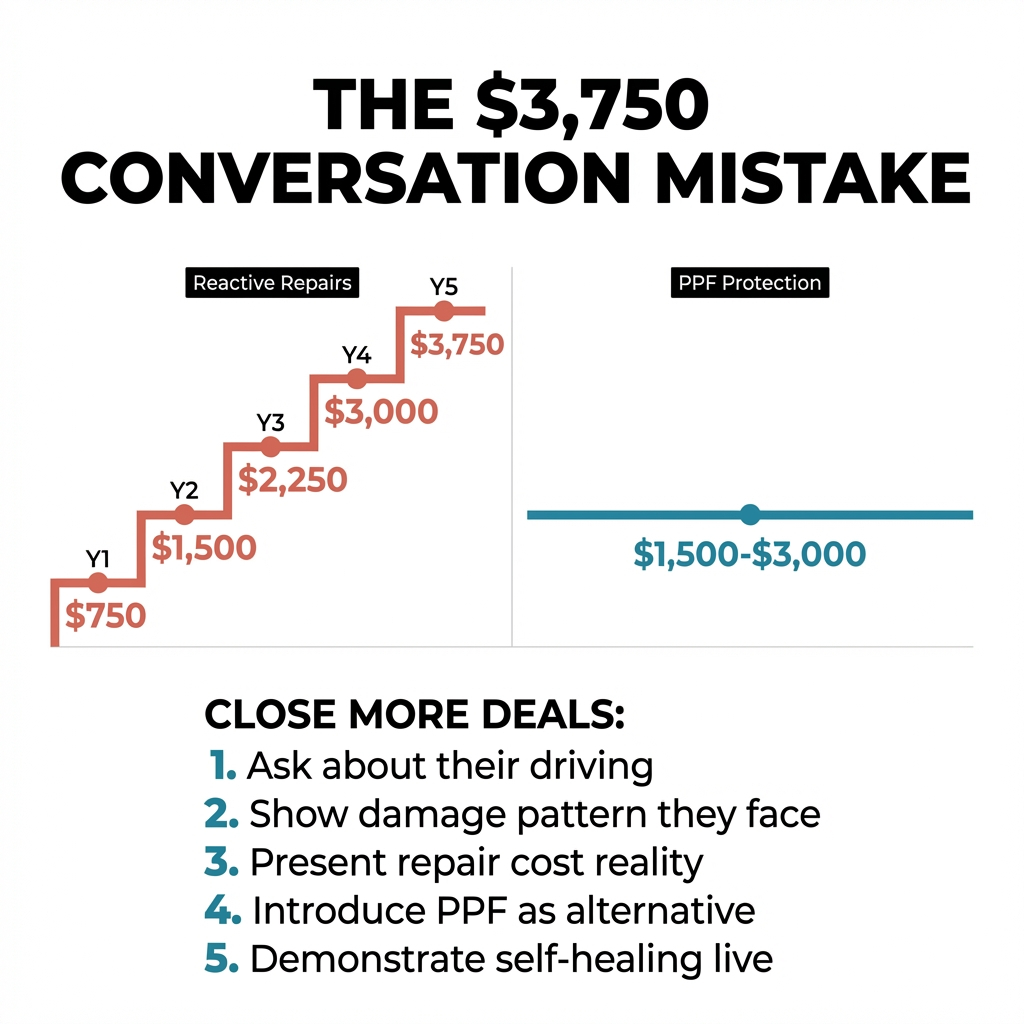
Here's how I structure PPF conversations now.
Start with their situation, not your product. How often do you drive on highways? Do you park in lots where other cars are close?
Show them the damage pattern they're facing. Based on that driving pattern, you'll probably see 3 to 5 rock chips per year on your front bumper and hood.
Present the repair cost reality. Each chip costs $100 to $150 to fix professionally. Over five years, this adds up to $1,500 to $3,750 in repairs.
Introduce PPF as the alternative. Front-end protection runs $1,500 to $3,000 one time. This eliminates those recurring repairs and maintains your resale value.
Demonstrate self-healing in person. Show them a sample. Scratch it. Heat it. Let them watch it heal.
Address the touch-up objection before they raise it. Some people think they'll fix chips as they happen. Here's why this doesn't work...
This structure moves the conversation from product features to financial logic. People buy when the math makes sense.
What separates this from random: The detailers closing PPF deals follow this pattern every time. The ones losing deals skip steps or start with product education instead of financial reality.
Building Systematic PPF Sales Infrastructure
Most detailers treat PPF as a premium add-on service. They mention it when customers ask. They don't systematically present it as the obvious financial choice.
The opportunity sits in the presentation infrastructure.
You need a repeatable conversation structure that walks customers through the damage pattern they're facing, the cost of reactive repairs, and the ROI of preventive protection. You need physical demonstrations that make self-healing technology tangible. You need the resale value data printed out and ready to show.
This isn't about selling harder. This is about installing a systematic approach to PPF conversations that produces consistent outcomes regardless of customer type or vehicle price point.
The detailers closing PPF deals aren't more charismatic. They're more systematic.
They've built infrastructure around a conversation that used to be random.
Frequently Asked Questions About PPF Sales
How long does PPF last on a vehicle?
High-quality self-healing PPF maintains effectiveness for 7 to 12 years with proper installation and maintenance. Premium films offer 10-year warranties against cracking, peeling, fading, and yellowing. The longevity depends on installation quality, film quality, and environmental conditions.
Does PPF work on all vehicle types or only luxury cars?
PPF works on any vehicle. Road debris doesn't discriminate by price tag. The cost comparison works for daily drivers and luxury cars. The difference is that luxury car owners already understand paint protection as standard practice, while daily driver owners need to see the same math apply to their situation.
What's the difference between full coverage PPF and partial coverage?
Full vehicle PPF covers the entire car and costs more. Partial coverage ($600 to $1,200) covers full bumper, partial hood, fenders, and mirrors. This protects the high-impact areas where 90% of rock chips occur. Partial coverage provides practical protection with measurable ROI for buyers who find full coverage too expensive.
How does self-healing PPF actually work?
Self-healing PPF contains polymers that flow back into their original shape when exposed to heat between 140°F and 160°F. Minor scratches disappear within 30 seconds to 5 minutes. You scratch a sample with your keys, pour warm water over it, and watch it heal. The technology works like an ice cube returning to its smooth state after being scratched and heated.
Is PPF worth the cost compared to fixing chips as they occur?
Yes. Professional rock chip repair costs $150 to $400 per panel. Vehicles typically experience 3 to 5 rock chips per year on front bumper and hood. Over five years, this adds up to $1,500 to $3,750 in repairs. Front-end PPF costs $1,500 to $3,000 one time and eliminates these recurring repair sessions. PPF reduces repair costs by 40% over five years.
How does PPF affect vehicle resale value?
Paint damage reduces a vehicle's resale value by 5 to 10% on average. For a $20,000 car, this means $1,000 to $2,000 lost value. 78% of car buyers consider exterior condition a critical purchasing factor. PPF preserves factory appearance and signals proper vehicle maintenance to buyers, protecting resale value.
Why doesn't touch-up paint work as well as PPF?
DIY touch-up paint kits create visible blobs that look as obvious as the original chip. They fill holes and prevent rust but rarely achieve cosmetic results that satisfy vehicle owners. Professional rock chip repair costs $150 per hour and compounds with each new chip. PPF prevents chips entirely for 7 to 12 years.
What should I include in my PPF sales conversation?
Start with their driving situation. Show them the damage pattern they're facing based on their habits. Present the repair cost reality over five years. Introduce PPF as the alternative investment. Demonstrate self-healing in person with a sample. Address the touch-up objection before they raise it. Move the conversation from product features to financial logic.
Key Takeaways: How to Close More PPF Deals
Lead with financial reality, not product features. Show the rock chip repair math: $150 to $400 per repair versus $1,500 to $3,000 one-time PPF investment. The math sells itself.
Demonstrate self-healing in person. Skip the chemistry lecture. Use the ice cube comparison and demonstrate it live with a scratch test in front of customers. Physical proof closes more deals than technical explanations.
Offer partial coverage to remove the luxury barrier. Partial PPF coverage ($600 to $1,200) protects high-impact areas where 90% of chips occur. This makes PPF accessible to practical buyers who find full coverage too expensive.
Frame PPF as resale value insurance. Paint damage reduces resale value by 5 to 10%. For a $20,000 car, this means $1,000 to $2,000 lost. When you frame PPF as insurance that protects resale value, practical buyers get it immediately.
Address the touch-up objection proactively. Don't wait for customers to raise it. Show them the blob reality of DIY kits and the $150 per hour cost of professional repair. Touch-up paint creates visible blobs and costs $150 per hour professionally. PPF prevents chips entirely for 7 to 12 years.
Follow the 6-step conversation structure every time. Start with their driving situation. Show damage patterns they'll face. Present repair costs over five years. Introduce PPF as the alternative. Demonstrate self-healing live. Address touch-up objections before they're raised. This structure moves the conversation from product features to financial logic.
Build systematic presentation infrastructure. The difference between closing PPF deals and losing them is systematic presentation infrastructure, not charisma. Create repeatable conversation structures. Keep physical samples ready for demonstrations. Print out resale value data to show customers. The detailers who build this infrastructure win consistently.